
Sustainable Manufacturing Gains Momentum in Mobility Aid Supply Chains
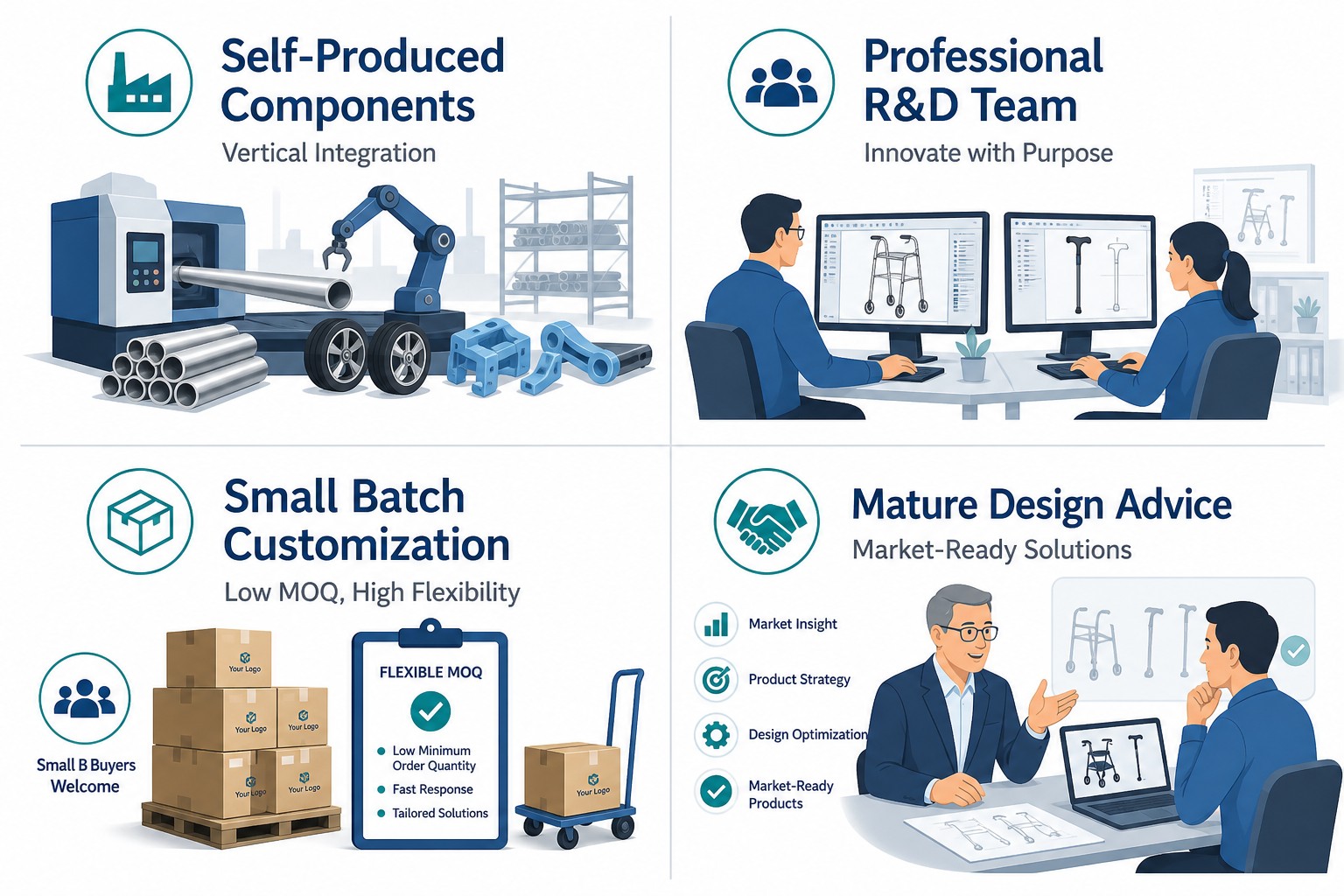
As global healthcare systems intensify their focus on environmental responsibility, sustainability has moved from a peripheral concern to a central criterion in B2B procurement decisions. Mobility aid manufacturers that integrate eco-conscious practices into their production pipelines are gaining a measurable edge when competing for contracts with hospital networks, GPOs, and government tenders. Key sustainability drivers reshaping the industry include the adoption of recyclable aluminum and carbon fiber composites, energy-efficient factory operations certified under ISO 14001, and reduced packaging waste through returnable shipping containers. For distributors, sourcing from manufacturers with documented environmental credentials simplifies compliance with increasingly stringent ESG mandates in North American and European markets. JiNDA Health Care has aligned its manufacturing processes with these evolving standards, maintaining ISO 13485 certification while progressively incorporating sustainable material sourcing and lean production techniques. The company’s 18-year track record in aluminum and carbon fiber fabrication demonstrates that durability and environmental responsibility can coexist without compromising product performance. For procurement professionals evaluating long-term supply partnerships, sustainability is no longer a “nice-to-have” — it is a qualification threshold. Manufacturers who can document their environmental footprint reduction alongside consistent product quality will secure preferred vendor status in the next generation of healthcare contracts.
JiNDA Launches 350 kg Bariatric Commode Chair for Heavy-Duty Care Settings

JiNDA Health Care has added a heavy-duty commode chair rated for 350 kg (770 lbs) to its OEM and wholesale product line, addressing the growing demand from nursing homes, hospitals, and bariatric care facilities for seating that accommodates higher-weight patients without compromising stability or hygiene. The new model joins an existing commode chair range spanning 120 kg to 250 kg capacities, completing the spectrum for institutional buyers who need a single supplier across all weight categories. The 350 kg commode chair features a reinforced carbon steel frame with a wider seating surface (62 cm inner width), double-crossbar bracing under the seat pan, and non-slip rubber feet with a broadened stance for tip-resistance. The flip-up armrests use a steel pivot mechanism rated for repeated heavy-load cycles, and the padded seat cushion is constructed from high-density foam with an anti-microbial vinyl cover — materials selected for both patient comfort and infection-control compliance in clinical environments. The bucket system uses a latched slide-out design that allows waste removal without requiring the patient to stand. For B2B buyers, the commercial significance of a 350 kg-rated commode chair is two-fold. First, it fills a gap in most institutional procurement catalogs — the majority of commercially available commode chairs max out at 200–250 kg, leaving bariatric care providers with no standard option. Distributors who carry a 350 kg model can capture that underserved demand and differentiate their catalog. Second, the existence of a full-range commode line (120 kg through 350 kg) from a single manufacturer simplifies vendor management and reduces the compliance overhead of qualifying multiple suppliers. The 350 kg bariatric commode chair is available for OEM branding with custom color, labeling, and packaging. Production MOQ is 200 units per SKU for OEM orders and 100 units for wholesale. Samples can be shipped from JiNDAu2019s US warehouse within 5 business days. Contact the JiNDA sales team for pricing and specification sheets.

Carbon Fiber Adoption in Mobility Aids: What B2B Buyers Need to Know Before Sourcing

Carbon fiber has moved from a premium niche to a mainstream material choice in walking canes, crutches, and rollator frames — and B2B buyers are taking notice. The material offers a 40–60% weight reduction over aluminum while maintaining equivalent or superior load capacity, making it particularly attractive for distributors serving aging populations who prioritize ease of handling. But the sourcing landscape is more complex than the specifications suggest, and procurement teams benefit from understanding the manufacturing realities before committing to carbon fiber product lines. The first consideration is manufacturing maturity. Not every factory claiming carbon fiber capability actually processes raw carbon fiber in-house. Many source pre-formed tubes from third-party suppliers and perform only cutting and assembly — which limits customization options and makes quality traceability harder. Buyers evaluating carbon fiber suppliers should ask three questions: Does the factory process raw carbon fiber (cut, lay-up, cure) on site? Can it produce custom tube diameters and wall thicknesses without minimum-order surcharges? Does it have pull-test data for the specific lay-up orientation used in each product? A factory that answers yes to all three — like JiNDA Health Care, with its dedicated carbon fiber workshop — provides the consistency and traceability that OEM and private-label programs require. The second consideration is cost positioning. Carbon fiber raw material costs remain 3–5× higher than aluminum, but the total landed cost gap narrows when factoring in shipping efficiency. Carbon fiber canes and crutches are lighter per unit, meaning more units per carton and lower per-unit freight — a meaningful difference on container shipments. For distributors targeting the premium senior market, the retail price premium for carbon fiber (typically 30–50% over aluminum equivalents) more than covers the higher wholesale cost, resulting in healthier margins per square foot of shelf space. For B2B buyers considering a carbon fiber product addition, the practical recommendation is to start with a high-visibility SKU — a carbon fiber folding cane or elbow crutch — and validate market response before expanding the line. JiNDA Health Care offers carbon fiber products with MOQs starting at 200 units per SKU for OEM orders, complete with ISO 13485-certified quality documentation and US warehouse availability for fast domestic fulfillment.

Smart Assistive Devices Redefine Mobility Aid Standards

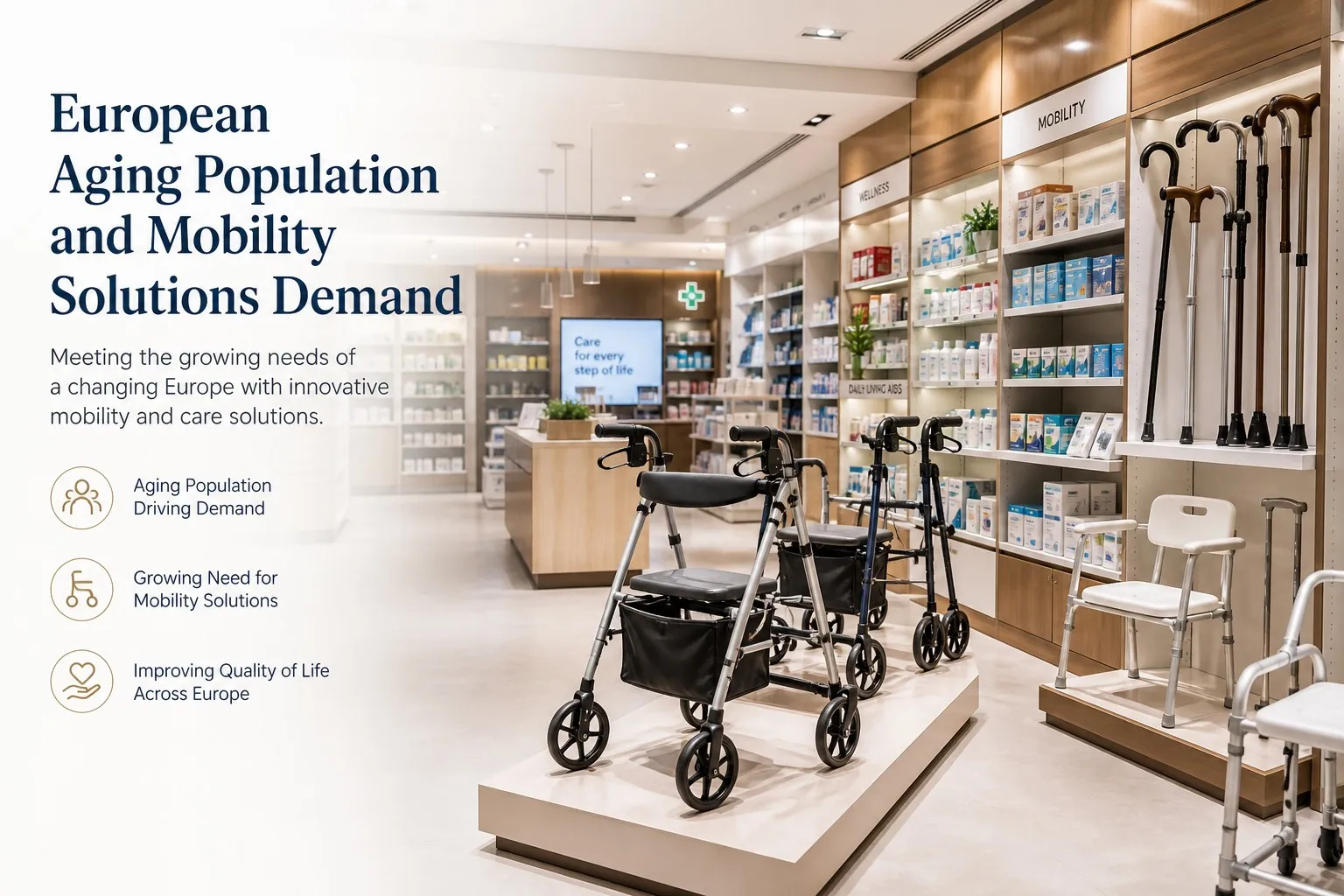
European pharmacy displaying mobility aids for aging population

The assistive mobility device industry is undergoing a fundamental shift as smart technology integration moves from concept to commercial reality. Sensor-equipped rollators, GPS-enabled walking canes, and fall-detection walkers are no longer prototypes—they are entering procurement catalogs and reshaping how healthcare facilities and distributors evaluate product offerings. For B2B buyers, understanding this transition is critical to staying competitive in a market where end users increasingly expect connected features alongside traditional durability and comfort. Several converging factors are accelerating adoption. Aging-in-place policies across North America and Europe are incentivizing technology-enabled home care, creating new reimbursement pathways for devices that offer monitoring, alerts, or telehealth integration. At the same time, component miniaturization has made it feasible to embed accelerometers, Bluetooth modules, and battery packs into lightweight frames without compromising weight or ergonomics—key requirements for users with limited upper-body strength. For distributors and OEM partners, smart mobility aids present both opportunity and complexity. Connected devices command higher average selling prices and create recurring service revenue through companion apps and data subscriptions. However, they also introduce new compliance considerations: FCC certification for wireless components, GDPR-aligned data handling for user analytics, and updated warranty terms for electronic subsystems. Procurement teams that proactively build expertise in these areas will secure early-mover advantages as demand scales. JiNDA Health Care is actively monitoring these technology trends to inform its product development roadmap. While the company’s current catalog focuses on proven mechanical designs optimized for mass production and OEM customization, its engineering team is evaluating sensor integration architectures that maintain JiNDA’s core values of reliability, affordability, and regulatory compliance. Partners interested in co-developing next-generation smart mobility solutions are encouraged to initiate technical discussions through JiNDA’s OEM desk.

JiNDA Achieves Zero-Defect Milestone in Quarterly QC Review

JiNDA quality control laboratory with advanced testing equipment

Quality consistency is the cornerstone of every successful B2B partnership in the medical device sector. JiNDA Health Care has once again demonstrated its commitment to manufacturing excellence by recording zero critical defects across its entire mobility aid production line during the latest quarterly quality control review. For distributors and procurement officers evaluating long-term supply partners, this milestone offers measurable assurance that every rollator, walker, and cane leaving the factory meets the rigorous standards expected by healthcare institutions worldwide. The zero-defect result spans all product categories—from lightweight aluminum rollators to heavy-duty bariatric walkers and ergonomic walking canes. Each unit undergoes a multi-stage inspection protocol that includes dimensional verification, load testing, and surface finish assessment before packaging. JiNDA’s ISO 13485-certified quality management system ensures that these checkpoints are not merely procedural but are embedded into the daily workflow of every production team, reducing variability and eliminating rework at the source. For wholesale buyers managing high-volume orders, defect rates directly impact landed costs through returns, replacements, and reputation risk. A zero-defect quarter translates into fewer customer complaints downstream, stronger end-user trust, and more predictable inventory planning. JiNDA’s consistent QC performance means that partners can confidently commit to larger order volumes without worrying about quality erosion at scale. As the global demand for reliable mobility aids continues to grow—driven by aging populations and expanding home care programs—JiNDA’s quality-first manufacturing philosophy positions it as a dependable OEM and ODM partner for brands and distributors seeking supply chain stability. The company invites prospective partners to request its latest quality audit report and schedule a virtual factory tour to witness the inspection process firsthand.

JiNDA Completes ISO 13485 Surveillance Audit, Reinforcing Compliance Commitment

JiNDA quality control laboratory with advanced testing equipment

ISO 13485 certification is not a one-time achievement—it requires annual surveillance audits and a full recertification every three years. JiNDA Health Care has successfully completed its latest surveillance audit, maintaining full compliance with the international standard for medical device quality management systems. For B2B partners, this annual verification carries significant procurement implications that go beyond a certificate on file. Surveillance audits examine whether a manufacturer’s documented processes align with actual production practices. Auditors review design control records, supplier qualification files, corrective and preventive action (CAPA) logs, and traceability documentation across the entire supply chain. A clean audit result confirms that the quality system is not merely theoretical—it is operational, enforced, and continuously improved. This distinguishes certified manufacturers from suppliers who hold certificates but operate with inconsistent quality controls. For distributors and group purchasing organizations, an unbroken audit record simplifies vendor qualification. Many North American and European procurement frameworks require suppliers to demonstrate ongoing compliance, not just initial certification. GPOs, VA contracts, and state procurement programs frequently request the last surveillance audit date as part of their vendor assessment. A current, clean record eliminates a common compliance barrier and shortens the approval cycle. JiNDA’s 18 years of manufacturing experience, combined with sustained ISO 13485 compliance, US local stock availability, and full OEM/ODM capabilities, provide the compliance and operational reliability that institutional buyers demand. Partners can request audit summary documentation and quality system records directly through the JiNDA B2B portal for their own vendor qualification files.

How GPOs Are Reshaping Mobility Aid Procurement in Long-Term Care

Mobility aids market projected to reach 12.5 billion by 2028

Group Purchasing Organizations have become the dominant procurement channel for North American long-term care facilities, controlling an estimated 30-35% of all medical supply contracts. For mobility aid manufacturers targeting this segment, understanding GPO contract structures is no longer optional—it is a prerequisite for market entry. GPOs aggregate purchasing volume across hundreds or thousands of member facilities, negotiating pricing tiers that individual nursing homes or assisted living centers could never achieve independently. This creates a double-edged dynamic: manufacturers gain access to large-volume orders with streamlined administrative overhead, but must accept thinner margins and meet stringent compliance benchmarks, including ISO 13485 certification, lot traceability, and documented lead-time guarantees. The evaluation criteria GPOs use extend well beyond unit price. Total Cost of Ownership (TCO) now factors in product durability rates, warranty claim frequencies, and the logistical cost of stockouts. Distributors who can demonstrate lower TCO through longer product lifespans, local warehousing, and responsive after-sales support consistently win contracts over lower-priced alternatives with higher replacement rates. This shift favors vertically integrated manufacturers who control both material quality and fulfillment speed. For B2B buyers evaluating mobility aid partners, GPO membership signals a manufacturer that has already passed rigorous credentialing. JiNDA Health Care maintains ISO 13485-certified production, US-based inventory for rapid fulfillment, and the OEM/ODM flexibility that GPO contract managers prioritize when specifying custom product configurations for their member networks.

European Mobility Aid Distributors Prioritize DDP and Local Stock Over Price

A clear shift is underway in how European mobility aid distributors evaluate Chinese suppliers. While price remains a baseline requirement, the decisive factor is increasingly logistics capability — specifically, whether a manufacturer can offer DDP (Delivered Duty Paid) delivery or maintain stock within the EU. For distributors in Germany, the Baltics, Scandinavia, and the Iberian Peninsula, the difference between FOB and DDP is the difference between a manageable supply chain and a customs compliance headache. The regulatory environment is driving this shift. Under EU MDR (Medical Device Regulation), importers bear significant compliance responsibility — registration, labeling verification, post-market surveillance — that goes far beyond simply clearing customs. Distributors who import under FOB terms must absorb these obligations themselves, adding cost and risk. A supplier who can deliver DDP, with pre-clearance documentation and CE-marked products, eliminates that burden and becomes a far more attractive partner. The same logic applies to local stock: product already warehoused in the EU can be shipped next-day, bypassing the 4–6 week sea freight lead time entirely. For Chinese manufacturers, this means that the value proposition for the European market is no longer just about competitive pricing. It is about providing a logistics framework that makes it easy for EU buyers to do business with you. JiNDA Health Care has responded to this demand by offering DDP delivery across the EU, supported by full export documentation (Commercial Invoice, Packing List, Certificate of Origin, Certificate of Conformity, CE compliance files) and the ability to consolidate mixed-SKU orders into single shipments. For distributors who need faster availability, JiNDA also supports local warehousing arrangements in key European markets. The message for EU distributors is straightforward: if your current supplier can only offer FOB, you are carrying compliance risk and inventory latency that your competitors are not. A manufacturing partner with DDP capability and EU logistics support lets you focus on sales and service rather than import administration. Contact JiNDA to discuss a logistics plan tailored to your European operation.

Build-to-Print Manufacturing: How JiNDA Evaluates Your Technical Package in 48 Hours

For mobility aid brands with in-house engineering teams, the fastest path from concept to production is Build-to-Print OEM: you provide the drawings, and the factory manufactures exactly to spec. The critical question buyers face is how quickly a factory can confirm feasibility — because every day of uncertainty delays your launch timeline. JiNDA Health Care has formalized its Build-to-Print evaluation process into a structured 48-hour DFM review. When a technical package arrives — whether it includes 2D drawings, 3D STEP files, or physical samples — our engineering team dissects it across five dimensions: material availability and cost, manufacturing process compatibility (metal fabrication, injection molding, upholstery, mechanical assembly), tolerance achievability, tooling complexity and lead time, and regulatory certification requirements for the target market. The output is a written feasibility report with a fixed-price tooling quote and a project timeline — not a vague “we can do it” email, but a data-backed assessment that lets your procurement team proceed with confidence. This process was developed through years of OEM projects for walkers, rollators, commode chairs, and bath safety equipment. Common findings during DFM reviews include tolerance stacks that exceed what standard tooling can achieve, material substitutions that reduce cost without compromising performance, and assembly sequence optimizations that lower labor hours. These are value-adds that a price-only factory will never surface — and they are the reason experienced buyers choose a manufacturing partner with engineering depth, not just production capacity. Every Build-to-Print project at JiNDA is assigned a dedicated project engineer who serves as a single point of contact from DFM review through first-article inspection and into mass production. Combined with ISO 13485-certified quality management, in-house tooling, and a US warehouse for domestic fulfillment, the result is a manufacturing partnership that reduces your total cost of ownership — not just your unit price. Submit your technical package today and receive a feasibility assessment within 48 hours.

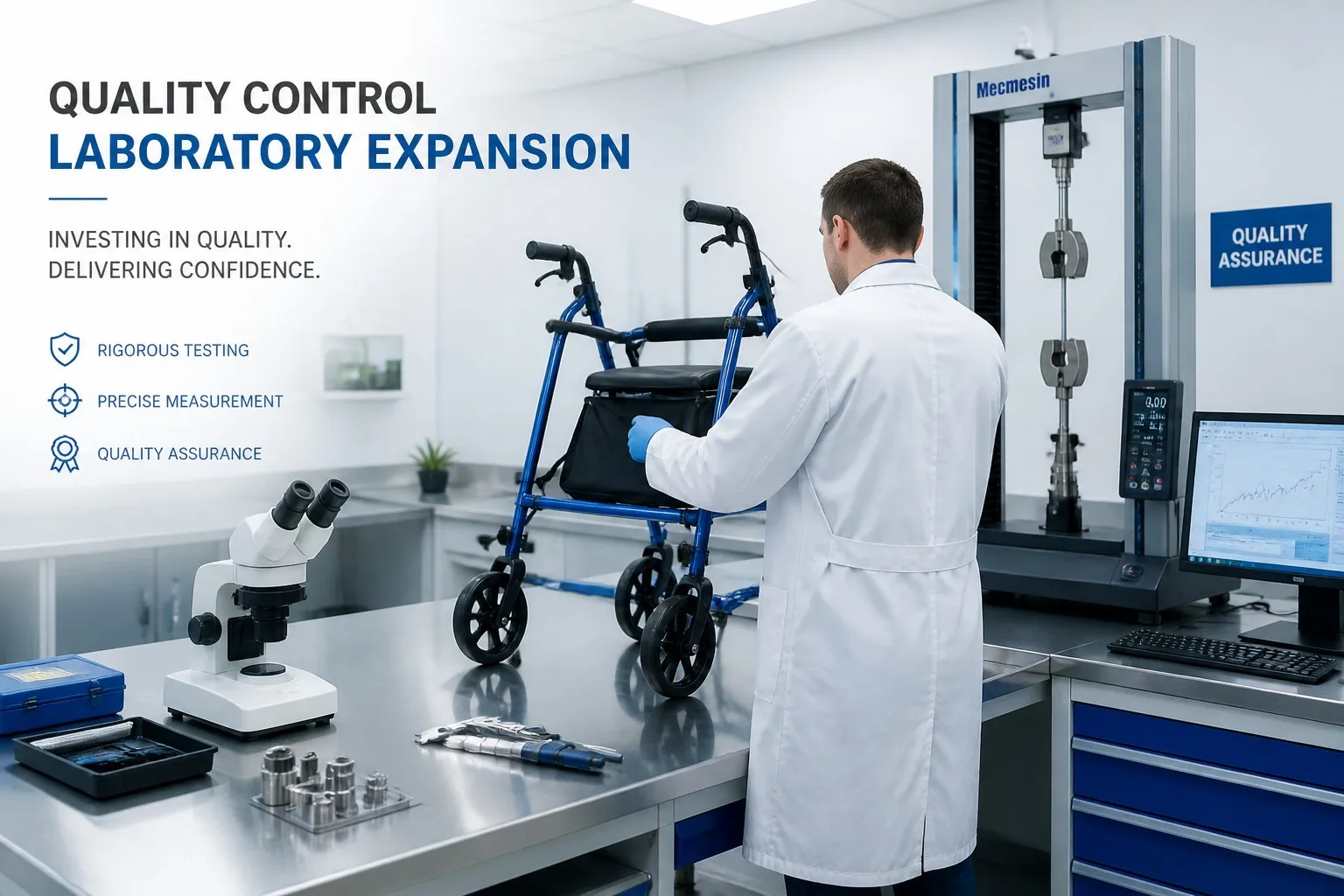
JiNDA Strengthens Quality Control Infrastructure with Expanded Testing Laboratory

JiNDA Health Care has completed a significant upgrade to its in-house testing laboratory, adding new equipment for fatigue cycle testing, load verification, and material composition analysis. The investment reinforces the companyu2019s ISO 13485-certified quality management system and responds directly to the increasing due-diligence requirements of international B2B buyers. The expanded lab now includes a servo-hydraulic fatigue testing system capable of simulating 100,000+ load cycles on walker and rollator frames, a universal tensile tester for verifying weld joint and material strength, and a spectrometer for incoming raw material verification. These additions allow JiNDA to perform 100% functional testing on finished products and statistical process control on critical dimensions — without relying on third-party testing facilities, which reduces both lead time and cost for OEM customers. For distributors and importers, the practical benefit is faster compliance documentation. Every production batch now ships with in-house test reports covering dimensional inspection, load capacity verification, and material certification — data that regulatory bodies and purchasing departments increasingly require before approving new suppliers. The testing data is archived digitally, enabling traceability for any shipment within the past five years. This laboratory expansion is part of JiNDAu2019s broader commitment to building the infrastructure that global buyers expect from a Tier 1 mobility aid manufacturer. Combined with existing capabilities — ISO 13485 and ISO 9001 certification, CE MDR and FDA compliance support, and a US warehouse for domestic fulfillment — the upgraded testing position ensures that quality assurance is embedded at every stage, from raw material intake to container loading. B2B partners evaluating JiNDA as a potential single-source supplier can request a virtual facility tour to see the testing lab and production lines firsthand.