B2B Procurement Shifts: Why Distributors Are Consolidating Mobility Aid Suppliers

Global mobility aid distributors are accelerating a structural shift toward fewer, more capable manufacturing partners. Rising logistics costs, tighter regulatory timelines, and the demand for faster product cycles are driving procurement teams to consolidate their supplier base — and the implications for Chinese manufacturers are significant. According to recent trade data, the average North American mobility aid distributor now works with 3–5 core factory partners, down from 8–12 five years ago. The rationale is straightforward: fewer suppliers mean lower transaction overhead, more consistent quality control, and stronger negotiation leverage on pricing and lead times. For distributors handling walkers, rollators, commode chairs, and bath safety equipment, this consolidation trend favors manufacturers who can deliver across multiple product categories under one roof. The key qualification criteria have shifted from price-first to capability-first. Distributors now evaluate factories on three dimensions: manufacturing breadth (can you produce walkers, canes, and shower chairs in the same facility?), certification depth (ISO 13485, CE MDR, FDA registration), and logistics flexibility (US warehouse stock, DDP delivery for EU buyers, mixed-SKU container consolidation). Factories that check all three boxes are capturing disproportionate order volumes. For B2B buyers evaluating supplier consolidation, the practical test is simple: can one factory handle 80% of your product catalog, maintain consistent lead times across SKUs, and provide unified documentation for customs and compliance? If the answer is yes, the total cost of ownership — including quality assurance overhead, communication costs, and freight efficiency — typically drops 15–25% compared to a fragmented supply chain. JiNDA Health Care, with its six-product-line manufacturing campus, ISO 13485 certification, and US warehouse, is positioned to serve as that single-source partner for distributors consolidating their mobility aid supply chains.

Total Cost of Ownership Reshapes Mobility Aid Sourcing

Global mobility aids market trends and data visualization

For years, mobility aid procurement was decided largely on unit price. That is changing. As distributors face thinner margins, higher freight costs, and more demanding institutional tenders, the buying decision is shifting from the cost of the box to the cost of the whole relationship, or total cost of ownership. TCO in this category is built from several layers that a unit price hides. Freight density matters: a compact, nesting rollator or a flat-folding commode chair allows significantly more units per container than a bulky alternative, which changes landed cost even when the invoice price is identical. Returns and warranty claims matter: a product that survives institutional use without a replacement cycle protects margin in a way a cheaper unit does not. Documentation matters: buyers who must answer a tender or a regulatory query need technical files, test reports, and consistent labelling, and gaps here create administrative cost that never appears on a price list. Service life matters: in rental fleets and nursing home settings, hardware that can be reconditioned and spare parts that remain available extend the revenue life of every unit. The practical effect is that buyers are increasingly asking suppliers for information that has nothing to do with price, including packing efficiency, spare-part availability, warranty terms, and the stability of the supply programme over multiple seasons. Suppliers that can answer those questions in structured form are winning programmes that a lowest-price bid would historically have taken. For JiNDA, this shift plays to a manufacturing model built around OEM/ODM collaboration rather than catalogue selling. Buyers can specify frame geometry, folding mechanisms, and packaging so that a product is optimised for their own logistics and service model, and receive the supporting documentation that makes the category defensible inside a tender. Distributors reviewing their mobility aid portfolio can request a cost-structure comparison from the JiNDA team.

JiNDA Expands Commode Chair Range for Home Care

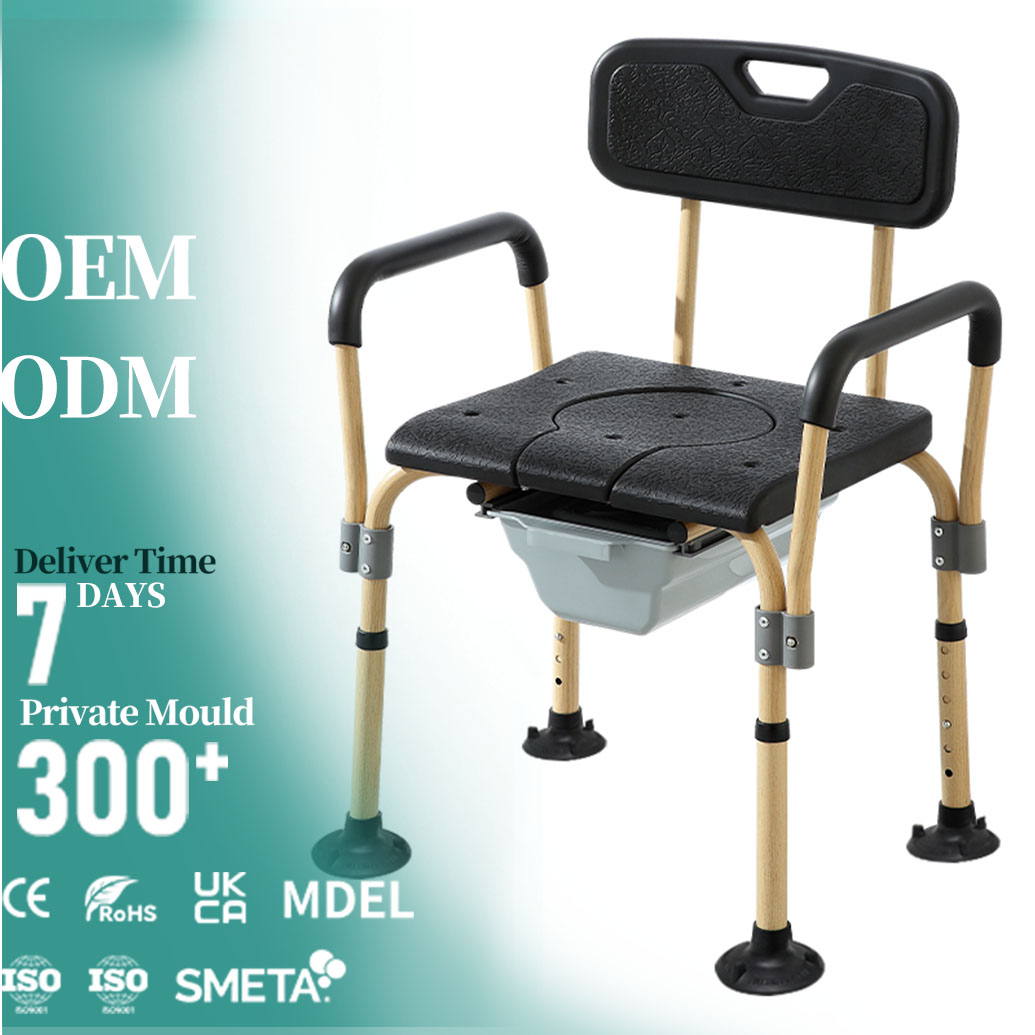
Durable Folding Commode Chair With Non Slip Design

Bathroom mobility remains one of the most under-served categories in home care equipment, even though it is the setting where falls are most likely to occur. JiNDA Health Care has expanded its commode chair and toilet safety range to give distributors a complete bath-safety offer that sits alongside its rollators, walking canes, and crutches. The expanded range covers three core product families: folding commode chairs with removable buckets, height-adjustable toilet frames with armrests, and widened toilet safety rails. Each family is built around the practical requirements that home care agencies and nursing homes specify, including powder-coated steel or aluminium frames for corrosion resistance in humid bathrooms, sealed seat surfaces that are easy to disinfect, and non-slip feet that remain stable on tiled floors. Seat height, frame width, and armrest geometry can all be adjusted through the OEM/ODM process, so that a private-label programme matches the sizing conventions of a specific market. For distributors, the commercial logic is straightforward. Bath safety is rarely bought as a single item: a pharmacy, home care dealer, or rehabilitation supplier that already stocks walkers and canes generally needs commode chairs, toilet rails, and bath benches for the same end user. Sourcing these from one manufacturer reduces the number of suppliers to audit, consolidates documentation and certification, and makes it possible to ship mixed containers rather than managing multiple lead times. A consolidated range also simplifies the retail story, because a complete bathroom safety set can be positioned as a coherent category rather than a collection of unrelated SKUs. JiNDA supports the range with private-label packaging, custom colour and hardware options, and the quality documentation that importers and institutional tenders typically require. Buyers evaluating the category can request samples, specification sheets, and container-load planning support directly from the JiNDA team.

JiNDA Upgrades Folding Rollator Line for Modern Needs

JiNDA lightweight rollator series product catalog shot

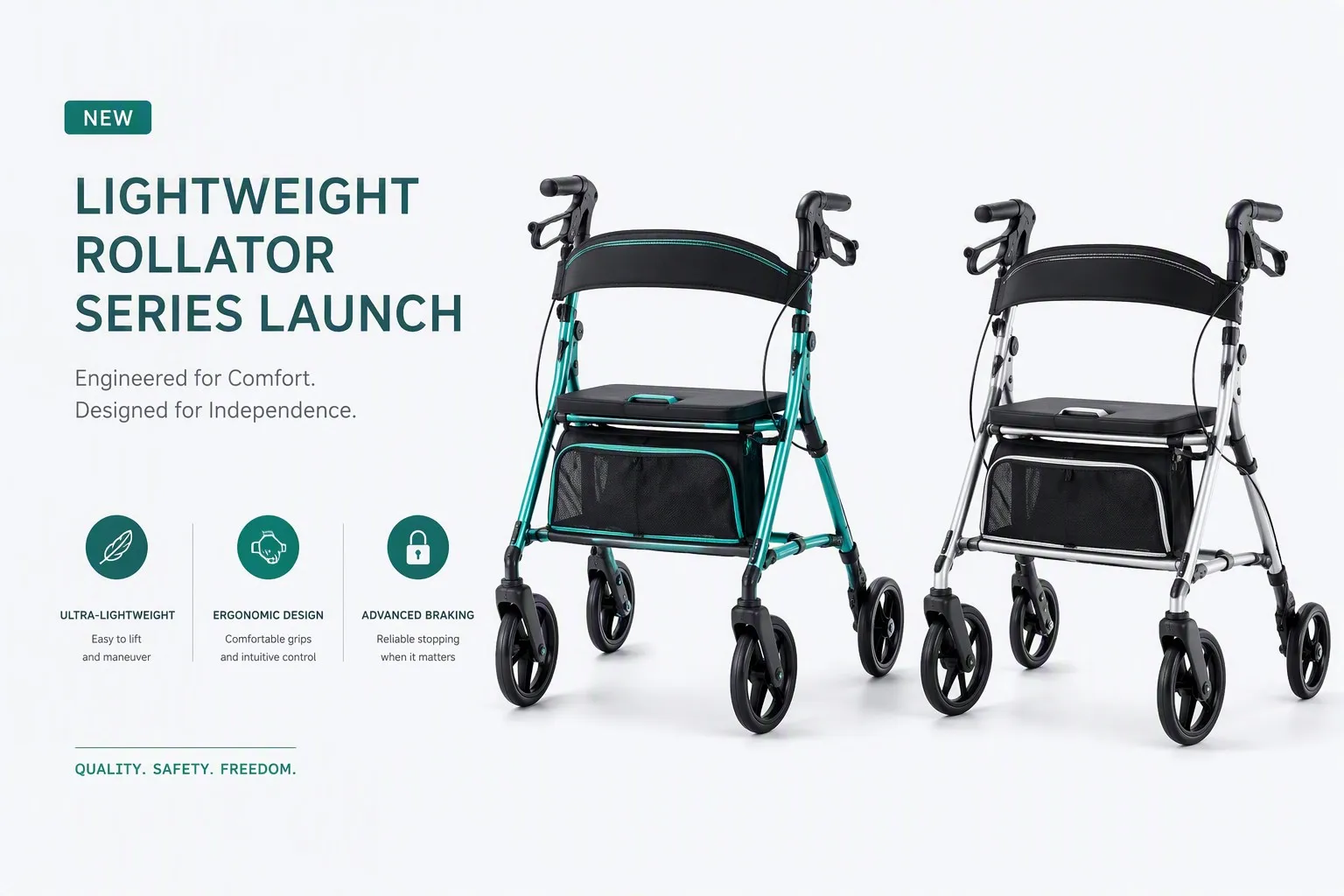
For older adults who need daily walking support, small design details decide whether a rollator becomes a trusted companion or a frustrating obstacle. A frame that feels too heavy makes every trip a burden, and a folding mechanism that needs two hands and awkward angles turns a simple car journey into a negotiation. JiNDA Health Care’s upgraded folding rollator series was engineered with these real-world moments in mind, bringing together light construction, dependable braking, and everyday convenience in one platform. The refreshed line centers on a lightweight aluminum frame paired with an easy one-hand folding system, letting users and caregivers collapse the rollator quickly for storage, public transport, or the trunk of a car. Height-adjustable handles accommodate users of different statures, while ergonomic grips reduce strain during longer walks. Lockable brakes provide confidence on slopes and when pausing to rest on the integrated seat, and a practical storage pouch with smooth-rolling wheels rounds out a design intended to support both indoor errands and outdoor outings with equal ease. Importantly for B2B partners, the upgraded platform is not a one-size-fits-all product. Rollator preferences vary meaningfully by market: average user height, local style expectations, accessory needs such as trays or cane holders, and packaging requirements for retail shelves all differ from region to region. JiNDA Health Care’s OEM/ODM model enables distributors and brands to start from a proven base platform and customize frame size, color, accessories, and branding, shortening time to market while keeping tooling investment and quality control firmly under control. The result is a product family that lets wholesalers and healthcare institutions build a tiered offering, from dependable entry models to feature-rich variants, under a single quality standard. Distributors interested in adding a modern, customizable rollator series to their catalog are invited to contact JiNDA Health Care for full specifications and sampling options.

Home Care Rehab Is Reshaping the Mobility Aids Market

Telehealth and home rehabilitation equipment solutions

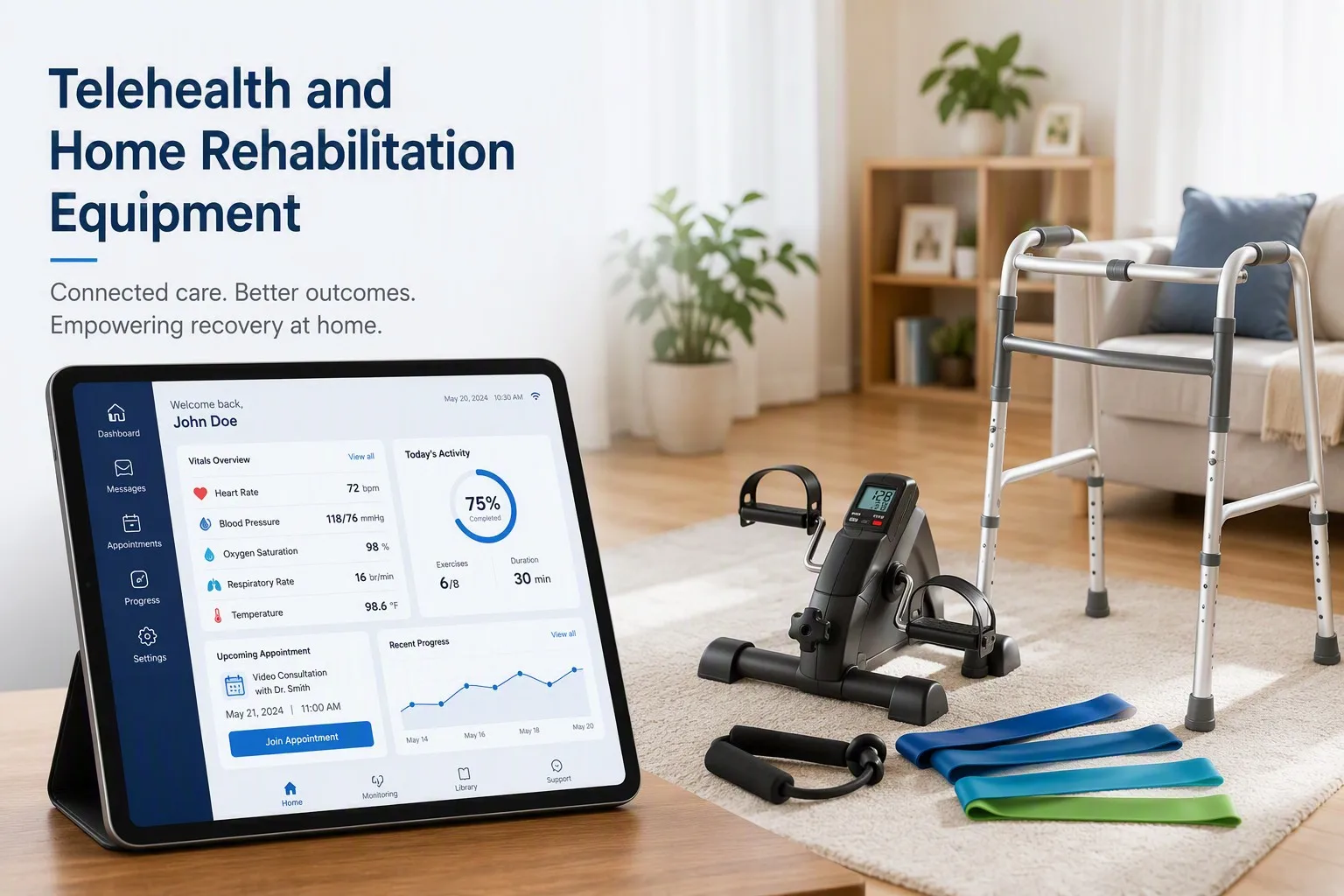
Rehabilitation is increasingly moving out of hospitals and into the home. Advances in telehealth, remote patient monitoring, and digital follow-up programs now allow many patients to complete long-term recovery in familiar surroundings, supervised by care teams at a distance. For wholesalers, distributors, and healthcare institutions, this shift is quietly changing the mobility aids market, and the way buying decisions are made. Equipment that once appeared mainly on hospital procurement lists is now a fast-growing line item in home care budgets, chosen by therapists, discharge planners, and family caregivers alike. The demands of home-based rehabilitation differ from those of institutional care. Mobility devices for the home must be lightweight enough to lift and store, easy to fold for transport, simple to adjust without tools, and forgiving for users who may still be recovering balance or strength. Safety features that reduce fall risk, such as stable bases, effective braking, and secure grips, matter even more outside a supervised clinical setting. At the same time, reimbursement frameworks in many markets are evolving to favor home care delivery, which is expected to keep broadening the range of users who acquire assistive mobility equipment through retail, pharmacy, and e-commerce channels. This has direct consequences for the supply chain. Distributors need product lines that span both institutional and home segments, with a wider range of specifications and price points to match. They also need manufacturing partners who can move quickly, refining weight, ergonomics, foldability, and finishing details in response to market feedback. JiNDA Health Care works with B2B clients as an OEM/ODM partner, supporting everything from concept development to serial production, so distributors can adapt proven platforms to the needs of their local home care markets without starting from scratch. For B2B buyers, the practical question is no longer whether home rehabilitation will grow, but how fast and in which segments. Suppliers that pair clinical-grade quality with home-oriented design, regulatory readiness across target markets, and flexible customization will be best positioned as purchasing power shifts toward the household. JiNDA Health Care welcomes distributors and healthcare institutions to explore how its mobility aid range can support home rehabilitation portfolios built for the years ahead.

Aging Policies Reshape Demand for Assistive Mobility Devices

European pharmacy displaying mobility aids for aging population

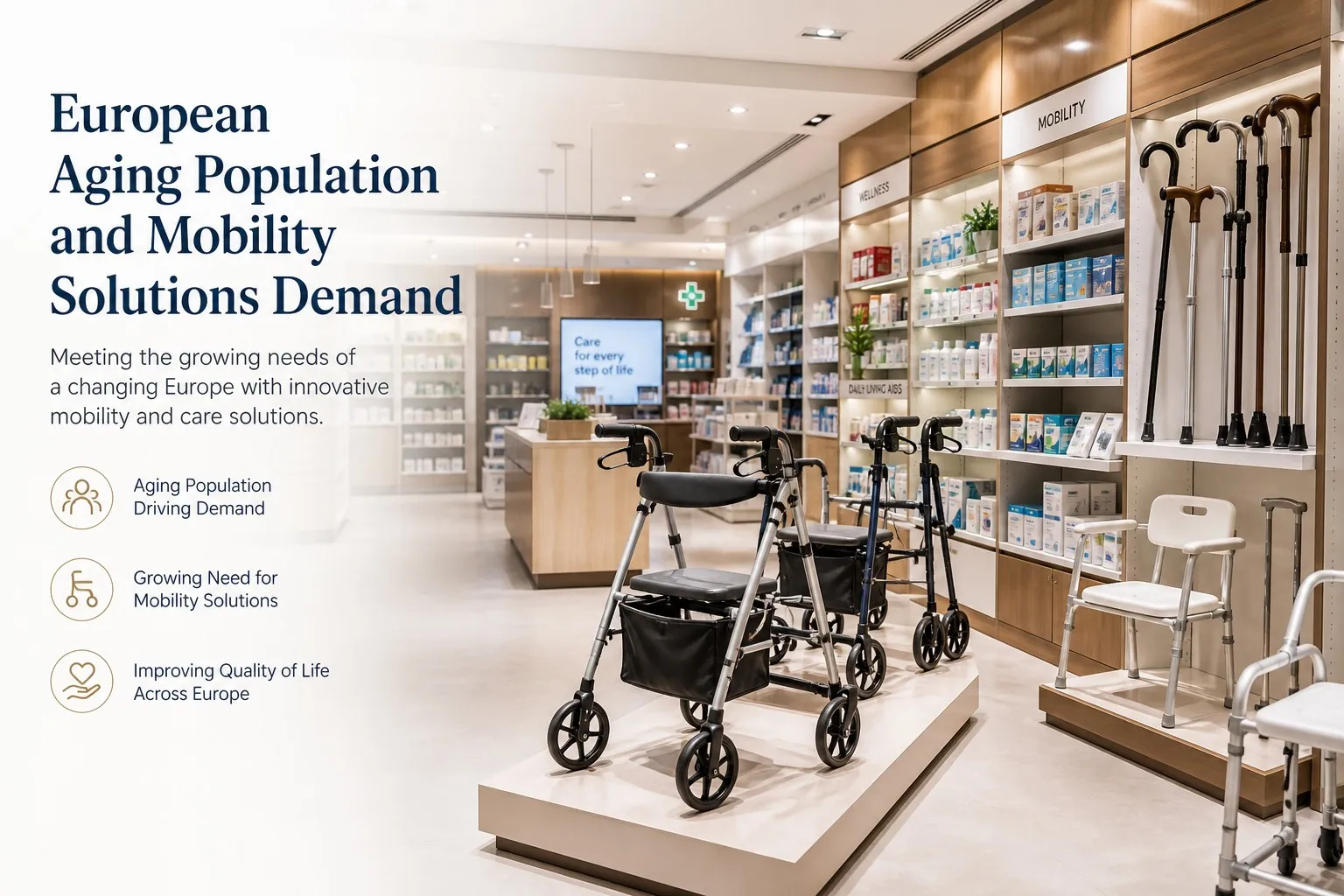
The world’s population is aging faster than at any point in modern history, and governments are responding with policies that turn demographic projections into funded demand. From long-term care insurance schemes to assistive device subsidy programs, public policy is becoming one of the strongest forces shaping the mobility aids market – a shift that matters directly for wholesalers, distributors and healthcare institutions planning their product lines. The mechanisms vary by region, but they point in the same direction. In mature markets, national long-term care insurance and reimbursement codes now cover walking aids and bathing safety equipment for eligible seniors, effectively subsidizing end-user purchases. Elsewhere, governments are introducing aging-care frameworks, VAT relief for assistive devices, and quality standards for equipment procured by nursing homes and rehabilitation centers. Wherever such policies take hold, demand for mobility aids moves from discretionary retail toward sustained, program-driven procurement. For B2B buyers, policy-driven demand changes procurement priorities in several practical ways. First, products purchased through public programs must meet documented quality and safety standards, so certification files and consistent manufacturing matter more than ever. Second, reimbursement models favor durable, repairable equipment with predictable service life, which raises the bar for build quality across volume orders. Third, as care programs expand into home and community settings, the product mix shifts toward user-friendly models – folding rollators, height-adjustable walkers and ergonomic shower chairs that non-professional caregivers can manage confidently. The direction of travel is clear: as more governments introduce or expand aging-care policies, assistive mobility equipment will increasingly be procured through structured programs rather than one-off purchases. Distributors and institutions that understand these regulatory environments – and carry compliant, quality-assured product ranges to match – will be best positioned as the policy wave spreads. JiNDA Health Care supports partners in this transition with a full portfolio of mobility and bath safety products, helping distributors respond quickly as new programs and standards emerge in their markets.

JiNDA Showcases Aging-Care Range at Global Trade Fairs

JiNDA Health Care exhibition booth at Medica 2026

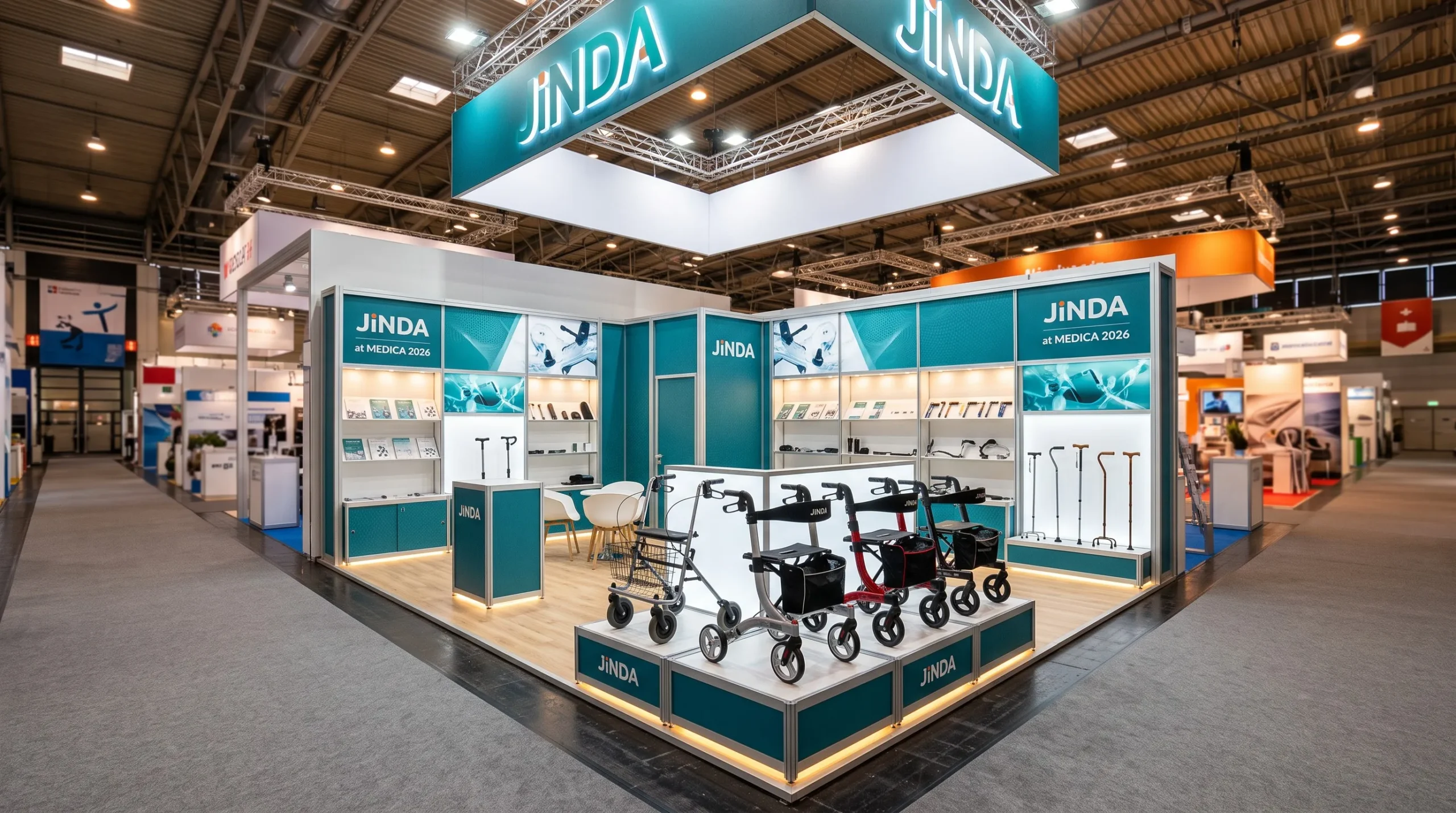
For wholesalers and distributors of medical mobility equipment, international trade fairs remain one of the most reliable ways to evaluate suppliers at scale – and for manufacturers, they are where long-term partnerships begin. JiNDA Health Care brings its full aging-care portfolio to major medical and rehabilitation exhibitions around the world, giving buyers a hands-on look at products that support independent living across walkers, rollators, canes, crutches and bath safety equipment. A JiNDA booth is designed for practical evaluation rather than passive display. Distributors can test the folding mechanisms of lightweight rollators, compare materials across aluminum and carbon fiber walking aids, and check the stability and ergonomics of shower chairs firsthand. Product specialists are on site to explain manufacturing standards, quality control procedures and customization options – the kind of detail that is difficult to assess from a catalog or a website alone. Beyond the products themselves, conversations at these events shape how JiNDA serves its B2B partners. Buyers discuss regional market needs, packaging preferences, private-label requirements and delivery expectations face to face, allowing the company to align its OEM and ODM programs with real demand. For many distributors, the show floor is also the fastest route to clarifying sample policies, minimum order quantities and production lead times with decision-makers in the same room. For partners who cannot attend in person, JiNDA keeps the same information accessible through its product catalog and direct consultation channels. Whether a buyer meets the team at an exhibition or online, the goal remains the same: a clear picture of how JiNDA’s manufacturing capability, quality assurance and responsive customization can support their own customers. Wholesalers and distributors planning their next sourcing cycle are welcome to request catalogs, samples and OEM/ODM consultations at any time.

JiNDA Expands OEM/ODM Capacity for Global Mobility Partners

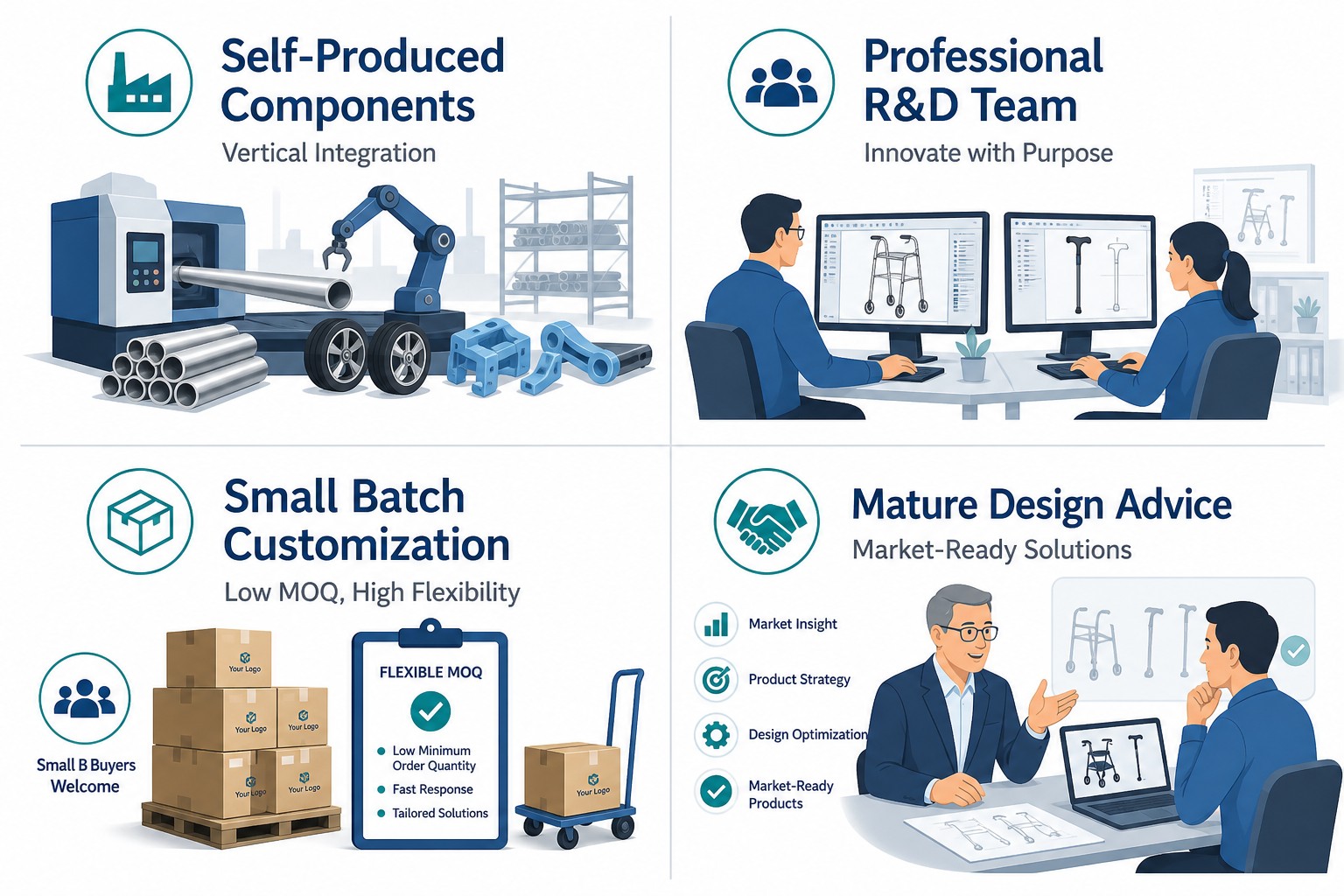
Behind every dependable mobility aid brand stands a manufacturing partner that can deliver scale, consistency, and speed. JiNDA Health Care has built its OEM/ODM programs around exactly that premise, supporting wholesale and distribution partners worldwide with walkers, rollators, canes, crutches, and shower chairs tailored to regional market needs. From product concept to container shipment, JiNDA’s OEM/ODM teams work alongside partners to adapt frame dimensions, weight, finish, and packaging to local preferences – whether the goal is a value-engineered line for emerging markets or a premium configuration for institutional buyers. Standardized production processes and in-house quality checks help ensure that every batch matches agreed specifications, a critical requirement for distributors managing multi-region inventory. Regulatory documentation is where many sourcing relationships stall, and JiNDA treats it as a core deliverable. Partners receive structured support on product documentation and compliance requirements common to major markets, alongside transparent communication on production schedules. Factory-level quality management and continuous process improvement are central to the company’s manufacturing operations, giving importers confidence in repeatable quality across order cycles. For B2B buyers, the value of a strong OEM/ODM partner extends beyond the unit price. Reliable lead times, responsive engineering support, and the flexibility to grow order volumes as demand expands reduce the total cost and risk of building a mobility aid portfolio. As regional demand for assistive devices continues to rise, JiNDA Health Care remains focused on one objective: helping partners bring dependable, market-ready products to their customers, faster.

Emerging Markets Reshape Global Mobility Aid Demand

Elderly woman walking with a rollator in a bright living room

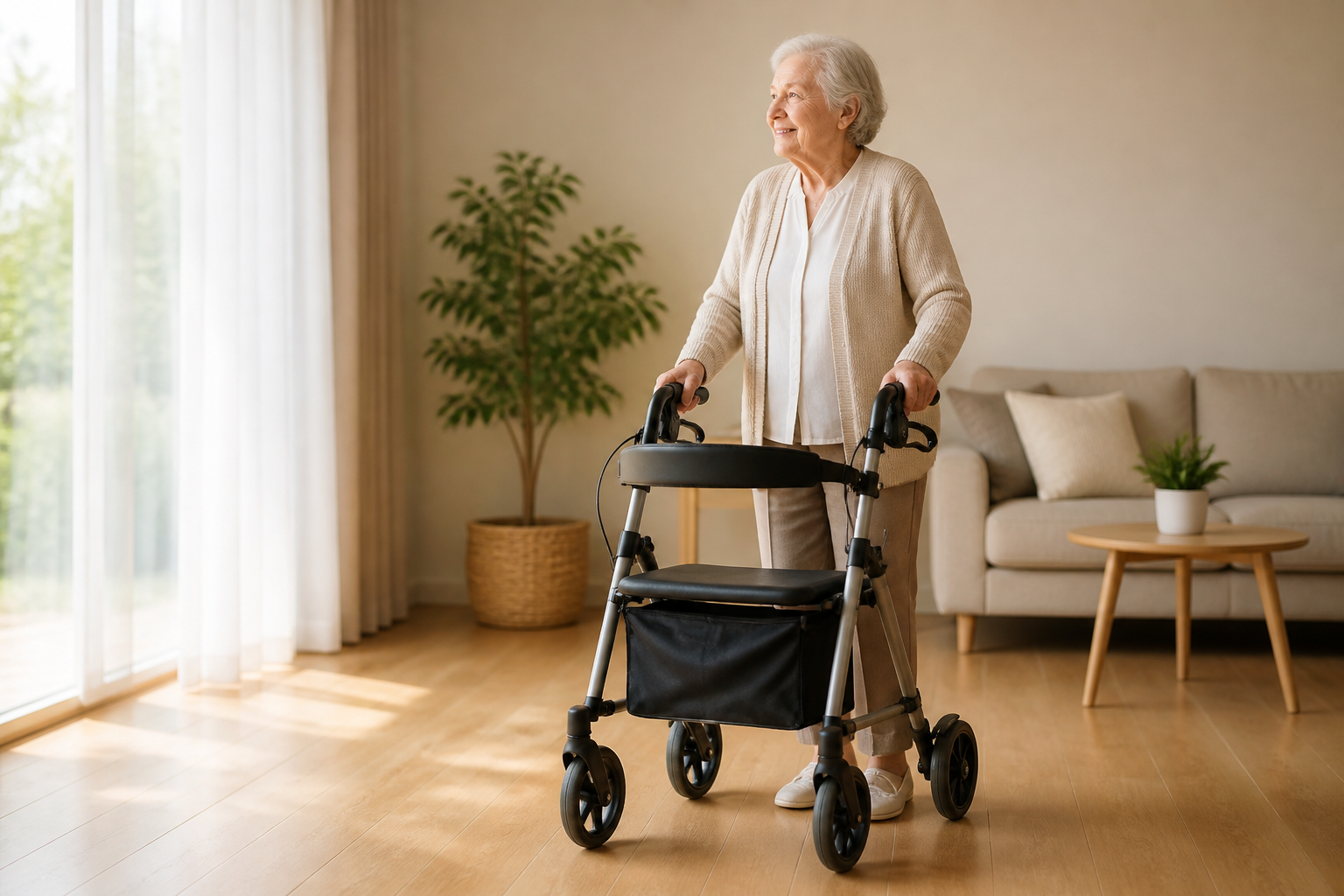
Global demand for mobility aids is no longer concentrated in a handful of mature markets. While North America and Western Europe remain the largest buyers of walkers, rollators, canes, and shower chairs, distributors and procurement teams are increasingly looking toward Asia-Pacific and Latin America, where aging populations, rising chronic disease rates, and improving healthcare access are creating new growth pockets. For B2B buyers, understanding these regional shifts is essential to building a resilient sourcing and distribution strategy. In Asia-Pacific, rapid urbanization and changing family structures are pushing more households toward professional care solutions, while government-led senior care initiatives in several countries are expanding institutional procurement of assistive devices. Latin America, meanwhile, is seeing steady growth in private healthcare spending and a growing middle class that prioritizes independence and comfort in later life. These markets tend to favor value-oriented products with clear certification, dependable lead times, and flexible OEM/ODM support – a combination that favors manufacturers with mature export experience. On the procurement side, the way mobility aids are bought is also evolving. Healthcare institutions and distributors are consolidating suppliers, emphasizing quality documentation, regulatory compliance, and after-sales service over price alone. Digital procurement platforms and cross-border trade channels are shortening supply chains, while environmental and social expectations are prompting buyers to evaluate factory practices and material sustainability as part of their vendor scorecards. For manufacturers such as JiNDA Health Care, these dynamics point in one direction: regional agility. A supplier that can tailor products to local usage habits, maintain consistent quality across large orders, and communicate transparently on compliance documentation is better positioned to serve both mature and emerging markets. Distributors that partner with such manufacturers gain a dependable route into the regions where mobility aid demand is growing fastest.

Global Mobility Aids Market Outlook for B2B Buyers and Distributors

Global demand for mobility aids — walkers, rollators, canes, crutches, and bath safety equipment — continues to expand as aging populations grow and healthcare systems shift more rehabilitation care into home settings. Industry forecasts project the market to approach USD 12.5 billion by 2028, driven by rising chronic conditions, post-surgery recovery needs, and a stronger focus on fall prevention among older adults. Regional dynamics differ meaningfully for B2B buyers. In mature markets such as North America and Western Europe, procurement increasingly favors suppliers with documented quality systems and regulatory compliance, including CE marking under the EU Medical Device Regulation and FDA registration for U.S. distribution. In emerging markets, price sensitivity is higher, yet demand for durable, standardized equipment is climbing as public and private healthcare networks expand. Buyers in both segments share a growing preference for direct factory sourcing that reduces intermediary costs. Several procurement trends are reshaping the distributor landscape. Private-label and OEM programs allow resellers to differentiate with their own branding while relying on manufacturers for engineering and compliance. Shorter lead times, reliable stock availability, and local warehousing have become deciding factors — particularly for buyers replenishing steady home-care demand. Digital channels also make it easier for importers to compare factories, request samples, and evaluate production capacity before committing to bulk orders. For distributors evaluating supply partners, the practical questions are straightforward: certification coverage, product range breadth, customization flexibility, and delivery reliability. JiNDA Health Care addresses these needs as a full-range manufacturer of mobility and bath safety equipment, offering OEM/ODM support, documented quality control, and overseas warehousing for faster regional fulfillment. Contact [email protected] to discuss pricing, samples, or private-label opportunities for your market.