
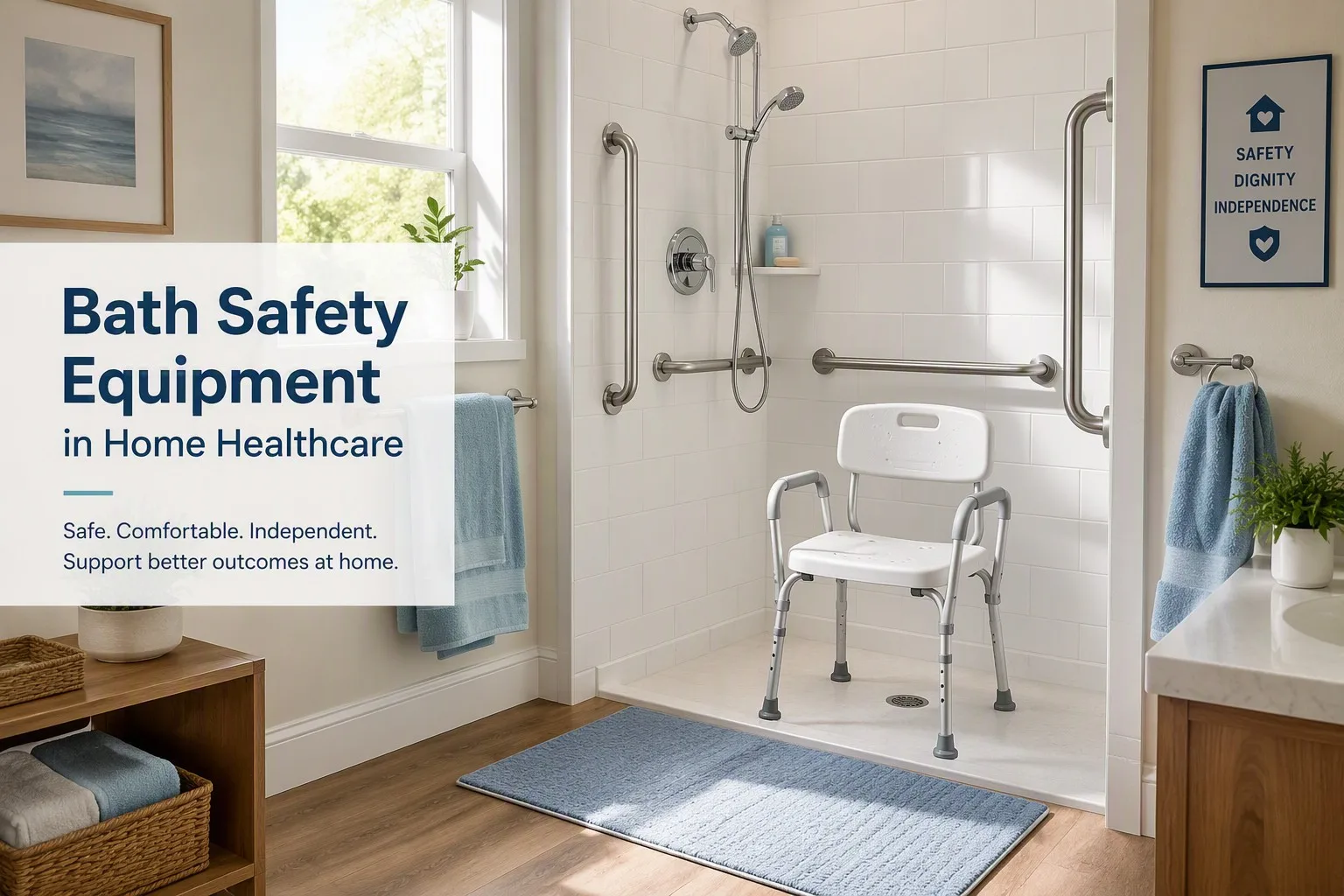
Bath Safety Equipment for Home Healthcare: A B2B Buyer’s Guide to Shower Chairs, Grab Bars, and Commodes
Bath safety equipment prevents the most common injury in home healthcare: the bathroom fall. For B2B buyers, the category covers three core products — shower chairs, grab bars, and commodes — each defined by weight ratings, materials, and clinical standards. Demand is accelerating as home healthcare expands and seniors age in place. CMS reports home health care spending reached $132.9 billion in 2022, up 6.0% from 2021. Bathroom and toilet assist devices form a $5.4 billion global market in 2025, projected to reach $9.6 billion by 2033 (Grand View Research). This guide explains what bath safety equipment includes, why falls drive demand, and how to evaluate products and suppliers. You will leave with a comparison table, a buyer’s checklist, and clear OEM/ODM guidance for your next sourcing cycle.
Key Takeaways
- Bathroom falls are the #1 injury risk for seniors — 1 in 4 older adults falls every year (CDC, 2024).
- Stock three core categories: shower chairs, grab bars, and commodes — the highest-turnover items in bath safety.
- Specify for the heaviest user, not the average user; weight capacity is the first spec to verify.
- Certification sells: ISO 13485 manufacturing and ISO 9999 classification signal compliant, sellable products.
- OEM/ODM flexibility lets distributors brand bath safety equipment without lowering quality standards.
What Is Bath Safety Equipment?
Bath safety equipment is any assistive product that reduces fall risk in the bathroom. It includes seating (shower chairs, bath stools), support (grab bars, handrails), and toileting aids (commodes, raised toilet seats). The International Organization for Standardization classifies these products under ISO 9999, codes 09 33 03 (bathing chairs and seats) and 09 33 06 (bath tubs and accessories). This system gives buyers a common language for specifying products across suppliers.
For distributors, this category offers three advantages. It serves a growing demographic. It generates regular replacement demand. And it fits standard logistics. A well-planned line covers three user groups: seniors at home, residents in skilled nursing, and patients in post-acute care.
Why Bathroom Falls Are the #1 Injury Risk for Seniors
Falls are the leading cause of injury-related death among adults aged 65 and older. The CDC (2024) reports that over 14 million older adults — 1 in 4 — fall each year, producing about 3 million emergency department visits and 1 million hospitalizations. In 2021, falls caused 38,000 deaths in this age group.
The bathroom is one of the most hazardous rooms in any home. Wet surfaces, hard fixtures, and tight spaces make transfers — entering the tub or moving to the toilet — the highest-risk movements of the day. Occupational therapists rank bathroom modification as a first-line fall prevention strategy. The WHO (2021) falls fact sheet names environmental hazards and a lack of assistive devices among the major risk factors.
For B2B buyers, the clinical case is also a commercial case. Facilities that prevent falls reduce liability and readmissions. Agencies that supply bath safety equipment improve outcomes and patient retention.
“The bathroom is where the day’s riskiest movements happen,” says Dr. Elena Rodriguez, OTD, OTR/L, Clinical Director at HomeSafe Rehabilitation Services. “A correctly selected shower chair or grab bar turns a dangerous transfer into a routine one. For facilities, that translates directly into fewer falls, fewer readmissions, and better outcomes.”
The 3 Product Categories to Stock
Shower Chairs
Shower chairs provide seated support during bathing. They come in standard, bariatric, and folding configurations. Standard models carry 250–350 lb (113–159 kg). Bariatric models reach 500–800 lb (227–363 kg). Folding models prioritize portability and small bathrooms. Browse the shower chair range for aluminum frames, adjustable legs, and tool-free assembly.
Grab Bars
Grab bars give users a secure handhold during transfers. Wall-mounted steel bars with anti-slip texture are the clinical standard. Suction-cup bars suit travel, but clinicians recommend daily checks and treat them as temporary aids. Key specs include load rating, flange size, and stud compatibility.
Commodes
Commodes solve toileting access problems. A 3-in-1 model works as a bedside commode, an over-toilet seat, and a shower chair. View commode models with removable pails, padded seats, and tool-free conversion.
Bath Safety Equipment Comparison Table
| Product Type | Weight Capacity | Key Features | Best For | Price Tier |
|---|---|---|---|---|
| Standard shower chair | 250–350 lb | Aluminum frame, adjustable legs, tool-free assembly | Everyday bathing support | Entry |
| Bariatric shower chair | 500–800 lb | Reinforced frame, wider seat, removable armrests | Higher-weight users | Premium |
| Folding shower chair | 250–400 lb | Compact fold, portability, height-adjustable | Small bathrooms, travel | Mid |
| Grab bar | 250–500 lb | Wall-mounted steel, anti-slip grip | Entry and transfer support | Entry |
| 3-in-1 commode | 300–500 lb | Bedside, over-toilet, shower use | Toileting safety | Mid |
How to Choose Bath Safety Equipment: A Buyer’s Checklist
Use this checklist to qualify products before you place an order.
- Confirm user weight and mobility level. Match weight capacity to the heaviest user, plus a safety margin.
- Measure bathroom dimensions. Door width, tub depth, and floor space determine which products fit.
- Check floor and drainage conditions. Non-slip feet and drainage holes prevent water pooling and slips.
- Review caregiver needs. Tool-free assembly, easy cleaning, and removable parts reduce staff burden.
- Verify certifications and test reports. Look for ISO 13485 manufacturing and documented load testing.
- Confirm MOQ, lead time, and warranty. Clear commercial terms protect your margin and your clients.
OEM/ODM Customization for Distributors
Private labeling is a standard growth lever in this category. Manufacturers with in-house tooling can customize bath safety equipment with your brand, colors, packaging, and spec changes — from seat width to frame finish. JiNDA supports OEM/ODM projects with engineering review, sample approval, and QC before shipment. Minimum order quantities typically start at container-level volume. Lead times vary with customization depth. Always request a spec sheet, load test report, and packaging mockup before committing.
Market Outlook: Why Home Healthcare Demand Is Growing
Three data points frame the opportunity. Grand View Research (2025) values the bathroom and toilet assist devices market at $5.4 billion, growing to $9.6 billion by 2033. CMS (2022) reports home health care spending rose 6.0% to $132.9 billion. And the CDC (2024) counts 14 million older adults falling each year — a number that will climb as the 65+ cohort expands. Bath safety equipment is a defensive healthcare category with consistent reorder demand. Pair it with rehabilitation equipment to build a complete home-care catalog.
FAQ: Bath Safety Equipment
Q1: What is the difference between a shower chair and a shower stool?
A shower stool has no backrest or armrests and suits users with good trunk control. A shower chair adds back support and often armrests, supporting weaker users during bathing.
Q2: What weight capacity should a bariatric shower chair have?
Look for at least 550 lb (250 kg). Heavy-duty models range from 500–800 lb. Always verify the load test report.
Q3: Are suction grab bars safe?
They are convenient for travel, but wall-mounted bars remain the clinical standard. Suction bars need daily checks and are not a permanent substitute.
Q4: What is a 3-in-1 commode?
It converts between bedside commode, over-toilet seat, and shower chair. Facilities value the versatility; verify tool-free conversion and easy cleaning.
Q5: What certifications should I look for in a supplier?
ISO 13485 for quality management and ISO 9999 product classification are baseline. Ask for load test reports and packaging compliance documentation.
Q6: Can I private-label bath safety equipment?
Yes. Reputable manufacturers offer OEM/ODM with branding, color, packaging, and spec customization, subject to MOQ.
Q7: What is a typical MOQ and lead time?
MOQs vary by model and customization level. Standard container orders ship faster; custom programs require tooling and sample cycles. Confirm both in writing.
Written by JiNDA Health Care | Reviewed by Dr. James Palmer, PT, DPT, ATP — Clinical Education Advisor
Last updated: August 2026