
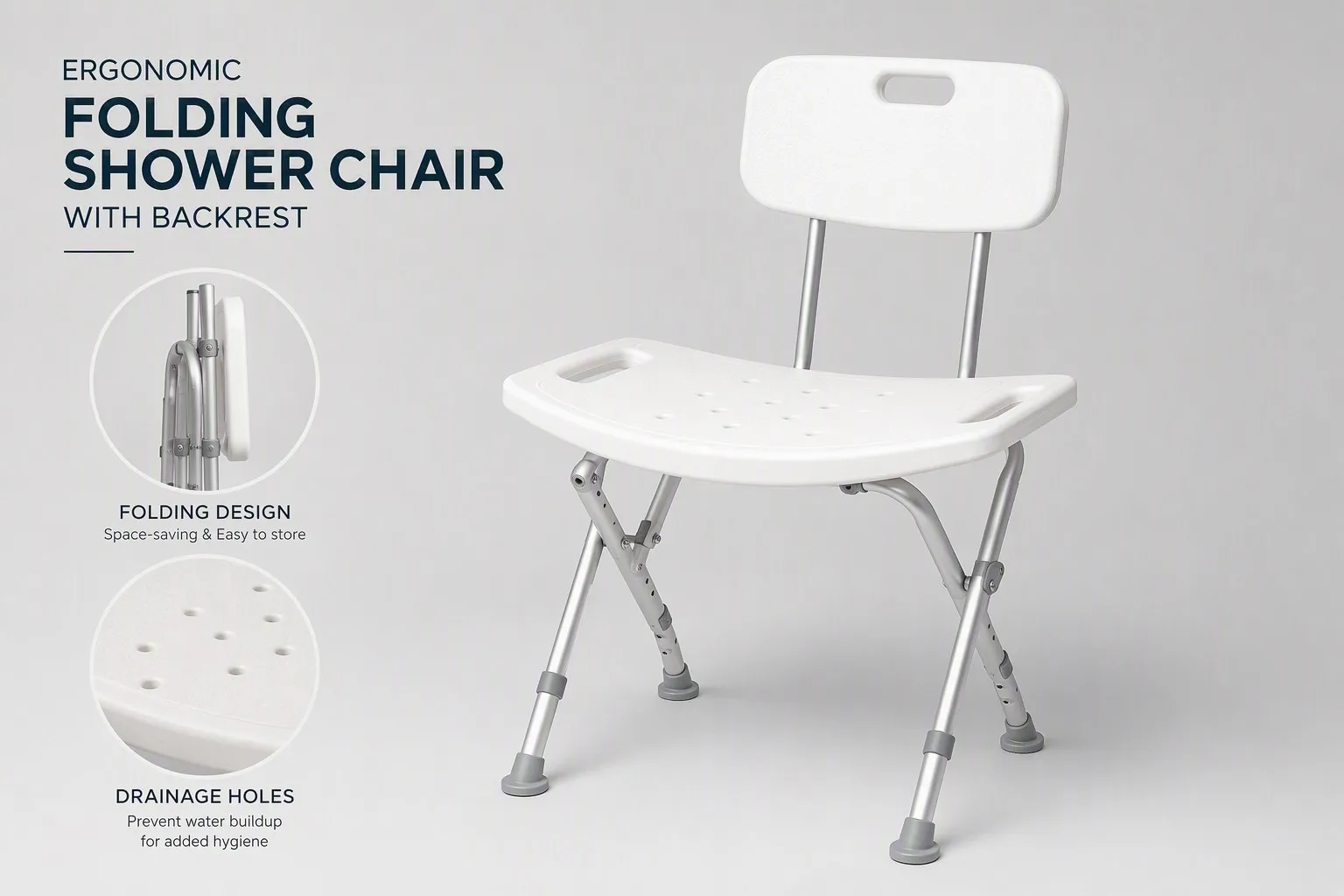
Folding Shower Chairs with Backrest: Why Ergonomic Design Matters for Home Healthcare Providers
A folding shower chair with backrest provides portable, back-supported seating for users who cannot stand safely in the shower. It folds flat for storage and travel, while the backrest delivers postural support that reduces fatigue and fall risk. For B2B buyers, the value is double: clinical benefit for the user, and logistics savings for the distributor. The market reflects this. Grand View Research (2025) values the bathroom and toilet assist devices market at $5.4 billion, growing to $9.6 billion by 2033. The CDC (2024) reports 1 in 4 older adults falls every year — over 14 million people. This guide explains what a folding shower chair with backrest is, why back support matters clinically, and which specs distributors should compare before sourcing.
Key Takeaways
- A backrest changes the clinical profile — it supports posture, cuts fatigue, and lowers fall risk during bathing.
- Folding design solves space problems — ideal for small bathrooms, travel, and temporary home setups.
- Height adjustability is a must-have for matching chair height to user leg length.
- Tool-free assembly reduces caregiver workload and returns chairs to service faster.
- For distributors, folding SKUs cut storage and shipping costs by up to 50% versus fixed frames.
What Is a Folding Shower Chair with Backrest?
A folding shower chair with backrest is a bathing seat that collapses for storage while providing full postural support during use. The frame folds flat, typically with a hinge mechanism, while the backrest supports the user’s trunk during washing. It differs from a fixed shower chair, which stays assembled, and from a wall-mounted fold-down seat, which attaches to the wall.
The target user cannot stand safely through a full shower but does not need a permanent fixture. Common scenarios: a senior bathing at home, a patient in a temporary rental, or a facility needing flexible seating across rooms. The chair delivers the safety of a fixed model with the portability of a travel product.
Why Backrest Support Matters for Bathing Safety
The backrest is not a comfort extra; it is a safety feature. During a shower, users lean, reach, and shift weight to wash. Without trunk support, each movement tests balance on a wet surface. An occupational therapist explains the mechanism:
“Ergonomics is about reducing the demands placed on an aging body,” says James Whitfield, OTR/L, Senior Occupational Therapist at Community Rehab Partners. “A backrest holds the trunk stable so the user can focus on washing, not on staying upright. That stability is what prevents the fall.”
Clinical benefits include improved posture during washing, reduced muscle fatigue for users with limited endurance, and a lower fall risk because the user remains seated and supported. Facilities also benefit: fewer falls means fewer incident reports, less liability, and better satisfaction scores.
Key Specifications to Compare
Foldability
Check the folded footprint and the folding mechanism. A chair that folds in seconds with one hand is easier for caregivers. Measure folded depth against your storage racks and delivery vehicles.
Seat Height Adjustability
Adjustable legs let clinicians match seat height to the user’s leg length. A proper fit keeps feet flat on the floor — a core fall prevention principle. Look for multiple height settings and tool-free adjustment.
Backrest Height
A backrest that reaches mid-scapula offers better support than a low rail. Confirm it is comfortable for washing and does not block caregiver access.
Anti-Slip Feet
Rubber suction feet grip wet tile. Verify foot design and replacement availability, since feet wear fastest in field use.
Tool-Free Assembly
Assembly requirements matter in facilities. Tool-free setups reduce staff time and eliminate the risk of loose hardware.
Shower Chair Comparison Table
| Feature | Folding Chair with Backrest | Fixed Shower Chair | Wall-Mounted Fold-Down |
|---|---|---|---|
| Portability | High — folds flat for storage/travel | Low — stays in place | Medium — wall-mounted |
| Installation | None — place and use | None — place and use | Requires wall mounting |
| Backrest support | Full trunk support | Full trunk support | Minimal or none |
| Best for | Small bathrooms, rentals, travel | Permanent home setups | Shared shower rooms |
| Price tier | Mid | Entry–Mid | Mid–Premium |
JiNDA’s Ergonomic Folding Shower Chair
JiNDA’s ergonomic folding model is built for the daily demands of home healthcare. Key features:
- Tool-free setup — unfolds and locks in seconds, no hardware required
- Height-adjustable seat — matches user leg length for a stable, safe position
- Corrosion-resistant frame — aluminum construction rated for daily wet use
- Compact fold — slim profile for closet storage and efficient shipping
- Anti-slip feet — secure grip on wet surfaces
- ISO 13485 certified manufacturing with load-tested ratings
The chair fits the shower chair range and pairs naturally with rehabilitation equipment for distributors building complete home-care programs.
Why Distributors Should Stock Folding Models
Folding designs change the economics of distribution. Storage is the first saving: a flat-folding chair uses a fraction of warehouse space versus fixed models. Shipping is the second: compact boxes mean more units per container and lower freight cost per unit. Inventory flexibility is the third: one folding SKU covers home, facility, and travel use cases that would otherwise need three products.
For MOQ planning, folding models are ideal first orders because they consolidate volume into fewer SKUs. Confirm fold dimensions, box size, and per-container unit counts with your supplier before committing. JiNDA provides full packaging specifications for distributors to calculate landed cost accurately.
FAQ: Folding Shower Chairs with Backrest
Q1: Who needs a folding shower chair with backrest?
Users who cannot stand safely through a full shower and need trunk support, especially in small bathrooms, rentals, or temporary care settings.
Q2: How much space does a folding shower chair save?
Folded depth is typically 10–15 cm, versus 40–50 cm for fixed models. That allows closet storage and denser shipping.
Q3: Is a backrest really necessary?
For users with limited trunk control or endurance, yes. It stabilizes posture, reduces fatigue, and lowers fall risk during bathing.
Q4: What weight capacity should I look for?
Standard models carry 250–400 lb (113–181 kg). Verify the load test report for your target user population.
Q5: What is the typical MOQ for folding shower chairs?
MOQs vary by supplier and customization. Standard models ship at container-level volume; OEM programs add sample approval cycles.
Written by JiNDA Health Care | Reviewed by Dr. James Palmer, PT, DPT, ATP — Clinical Education Advisor
Last updated: August 2026