
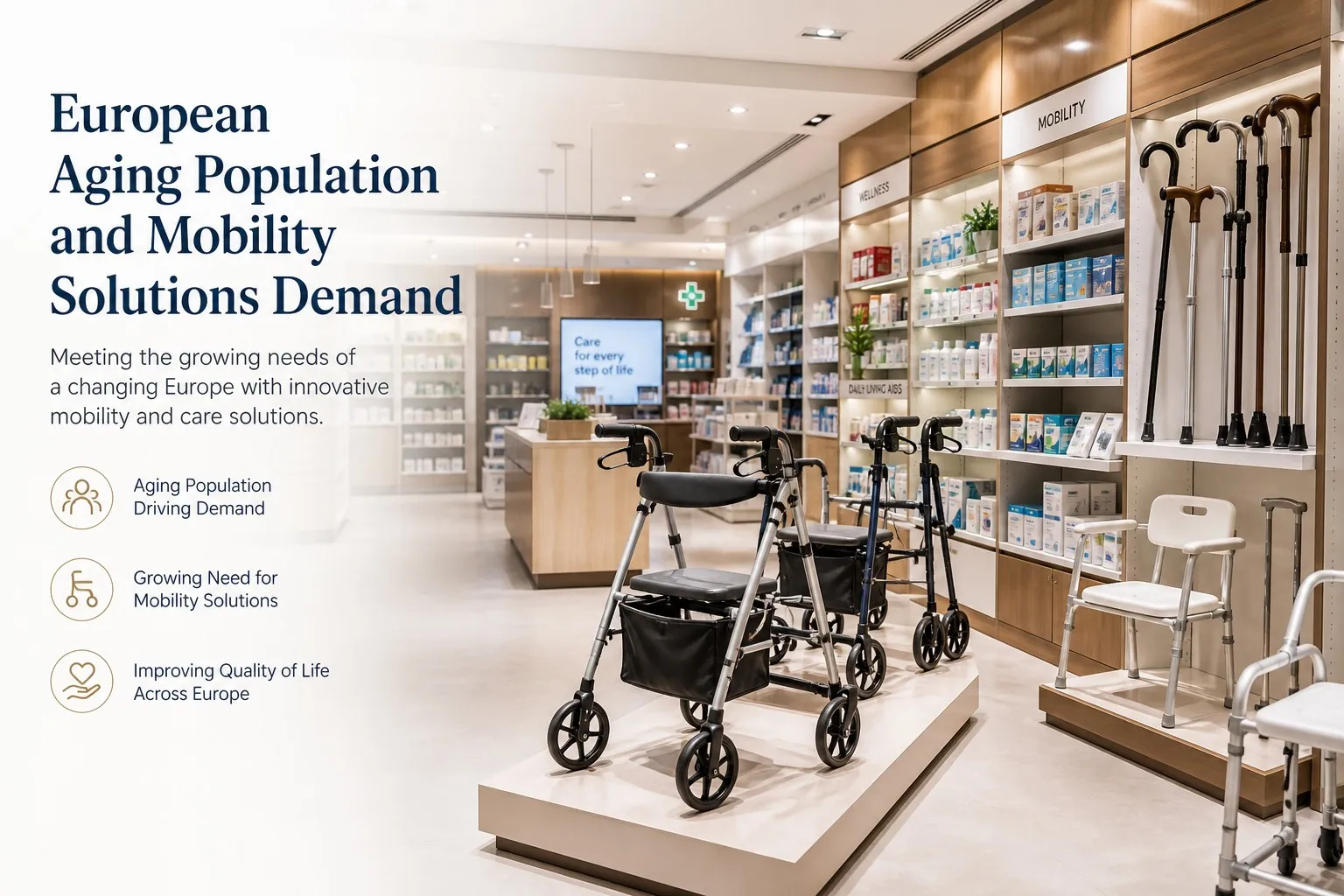
Europe’s Aging Population: How Demographic Shifts Are Reshaping the Mobility Aids Market
Category: Industry News
Europe’s aging population is the single largest demand driver reshaping the mobility aids market — and B2B buyers who secure supply now will capture the next two decades of growth. According to Eurostat, 22.0% of the EU population — more than 99 million people — was aged 65 or over on 1 January 2025. That share is projected to approach one in three by 2050. For wholesalers, distributors, nursing homes, and home healthcare providers, this demographic wave converts directly into sustained orders for rollators, bathroom safety products, and home care beds. This article explains how fast Europe is aging, which product categories are growing fastest, and where the strongest B2B opportunities remain.
Key Takeaways
- Europe’s 65+ population reached 22.0% in 2025 and is projected to approach one in three by 2050 (Eurostat).
- Rollators, bathroom safety products, and home care beds are the fastest-growing mobility categories.
- Aging-in-place policies convert demographic statistics directly into home-use equipment orders.
- Central and Eastern European markets remain underpenetrated and offer first-mover advantages.
- Certified suppliers with EU warehousing and low-MOQ customization reduce tender and pilot risk.
How Fast Is Europe’s Population Aging?
The data is unambiguous. On 1 January 2025, the EU population stood at 450.6 million, with 22.0% — over 99 million people — aged 65 or older (Eurostat, 2025). Three projections define the next two decades:
- Nearly one in three EU citizens will be aged 65+ by 2050.
- The 80+ age group — the heaviest users of mobility aids — is the fastest-growing population segment.
- The old-age dependency ratio will climb from one senior per three workers to more than one per two by 2050 (Eurostat, 2025).
The WHO European Region identifies falls as a leading cause of injury-related hospital admissions among older adults, which is why fall-prevention equipment carries strong procurement priority. Every European market now has a growing senior cohort and a shrinking caregiver ratio.
Which Mobility Aid Categories Are Growing Fastest?
Demand is rising across nearly every category, but growth concentrates where safety meets independence:
- Walkers and rollators. The backbone of the market. Seniors increasingly choose rollators with brakes, seats, and baskets for longer, safer outings.
- Bathroom safety products. Shower chairs, bath boards, and commodes are among the fastest-growing lines, because the bathroom is the highest-risk room in the home for falls.
- Home care beds. Hospital-at-home and early-discharge programs are pulling institutional bed demand into private homes.
- Fall-prevention supports. Height-adjustable frames, transfer aids, and bedside supports for safe sit-to-stand movement.
Distributors across Europe report sustained double-digit growth in these categories, with no plateau in sight.
Which European Markets Are Underpenetrated?
Western Europe — Germany, France, and the Nordics — is mature but high-volume. The sharper opportunity sits in Central and Eastern Europe, where populations age faster than home care infrastructure develops:
| Market cluster | Aging trend | Opportunity profile |
|---|---|---|
| Western Europe | 65+ share already above 20% | High volume, tender-driven, competitive |
| Central & Eastern Europe | Aging fastest, low equipment penetration | First-mover distribution, rising home care budgets |
| Southern Europe | 65+ share among the highest in the EU | Strong public procurement, reimbursement-driven |
“Demographic aging is not evenly distributed across Europe,” says Dr. Elena Kovacs, Senior Research Fellow, European Centre for Social Welfare Policy and Research. “Markets in Central and Eastern Europe are aging faster than their home care infrastructure is developing, creating a procurement gap that distributors and manufacturers can fill.”
How Should B2B Buyers Choose a European Mobility Supplier?
European tenders and care programs reward suppliers that combine certification with flexibility:
- ISO 13485 certification and CE marking for every product shipped into the EU.
- Complete documentation — test reports, declarations of conformity — ready for tender submissions.
- Low MOQs and customization so you can pilot products and adapt to local preferences.
- EU warehousing for consistent lead times and localized logistics.
How Can JiNDA Support European Distribution?
JiNDA Health Care has manufactured rollator walkers and bathroom safety products for 18 years under ISO 13485. European partners benefit from CE-certified product lines, a Poland-based warehouse for faster regional fulfillment, and low-MOQ customization for tenders and private-label programs. That combination shortens time-to-market for pilots and full distribution programs alike. Contact our team to discuss product lines and certification documentation.
FAQ
How much of the EU population is aged 65 or older?
As of 1 January 2025, 22.0% of the EU population — more than 99 million people — was aged 65 or over, according to Eurostat.
Which mobility products are growing fastest in Europe?
Rollators and walkers, bathroom safety products, and home care beds are growing fastest because they support safe, independent living.
Why is bathroom safety equipment in such high demand?
The bathroom is the highest-risk room in the home for senior falls, making shower chairs, bath boards, and commodes priority purchases for care providers.
Which European markets offer the best opportunity for new distributors?
Central and Eastern European markets offer the best first-mover opportunity because they are aging quickly with comparatively underdeveloped home care distribution.
What certifications should European buyers require from a mobility supplier?
European buyers should require ISO 13485 certification, CE marking under MDR, and test documentation covering load, fatigue, and corrosion.
Written by JiNDA Health Care | Reviewed by Dr. James Palmer, PT, DPT, ATP — Clinical Education Advisor
Last updated: August 2026