Bath Safety Equipment Market: Size, Segments, and Procurement Strategies for Healthcare Buyers
The bath safety equipment market is growing at a double-digit pace, driven by aging populations and the clinical cost of falls. The global bathroom and toilet assist devices market was valued at $5.4 billion in 2025 and is projected to reach $9.6 billion by 2033 (Grand View Research, 2025), while the US segment alone is estimated at $1.77 billion in 2026 (Mordor Intelligence, 2026). For healthcare buyers — nursing homes, home care agencies, DME distributors, and facility groups — bath safety equipment is a high-volume, high-frequency procurement category with clear clinical justification: 1 in 4 older adults falls every year, and about 1 million are hospitalized (CDC, 2026). This guide defines the market, compares product types, explains regional demand patterns, and details procurement strategies that protect margin and compliance.
Key Takeaways
- The bath safety equipment market is projected to grow from $5.4 billion in 2025 to $9.6 billion by 2033 (Grand View Research, 2025).
- Falls are the clinical driver: about 3 million older adults visit emergency departments and 1 million are hospitalized each year (CDC, 2026).
- Shower chairs, bath benches, and commodes serve different care settings — matching product to setting controls cost and liability.
- North American buyers should prioritize Medicare-compliant, documentation-ready products; European buyers must verify CE marking under MDR.
- Bulk pricing, MOQs, and OEM customization determine total cost of ownership more than unit price.
What is the bath safety equipment market?
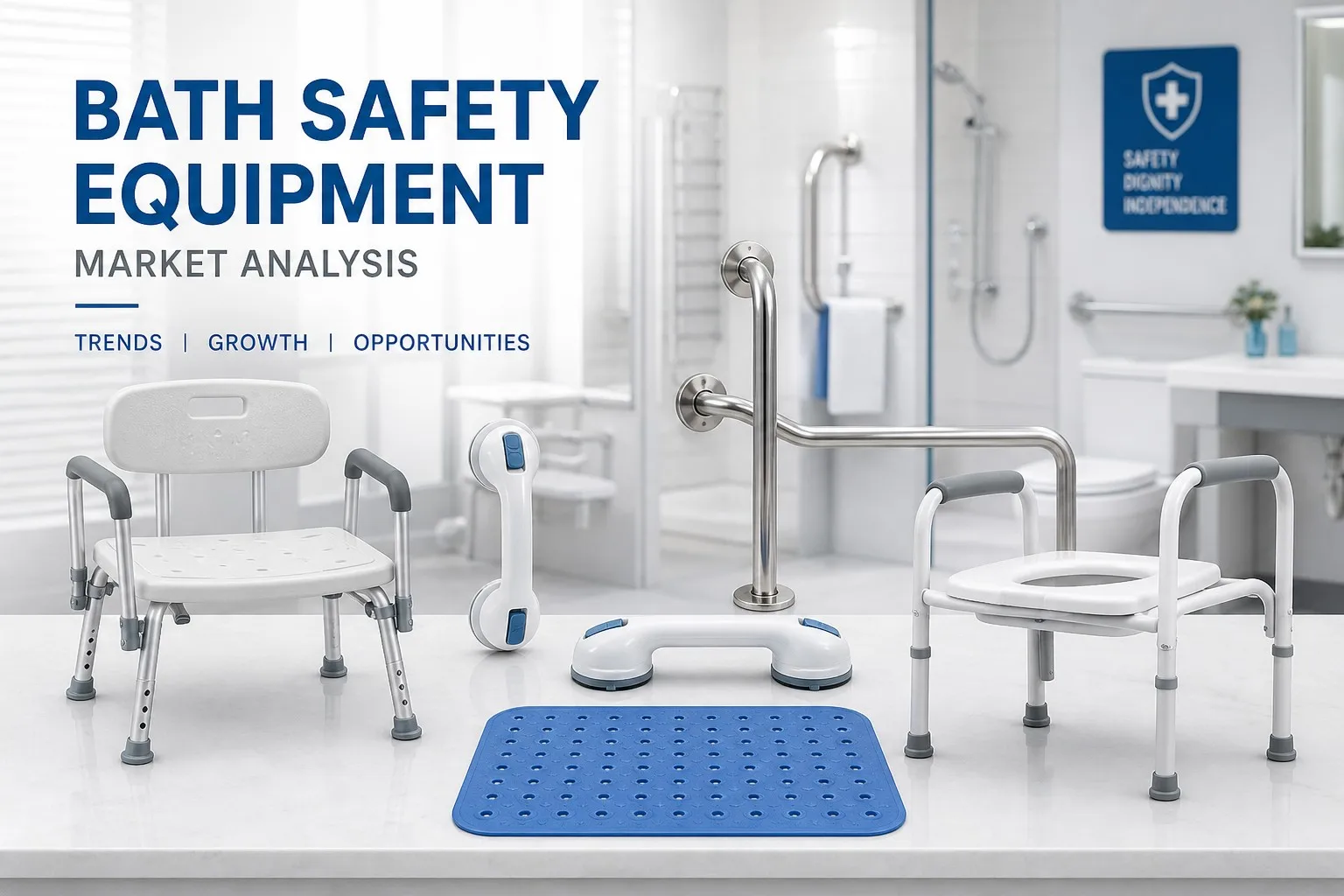
The bath safety equipment market covers products that reduce fall risk and enable independent hygiene in bathrooms and toilet areas. Core categories include shower chairs, transfer benches, grab bars, bath benches, commodes, and toilet safety frames. These products serve three demand pools: aging-in-place consumers, institutional facilities (nursing homes, assisted living), and post-acute home care programs.
The market definition matters for buyers because segment boundaries drive pricing. Grab bars and shower chairs are high-volume commodity lines; bariatric and custom-configuration products behave more like medical devices, with certification requirements and longer lead times.
What is driving demand for bath safety equipment?
Three demand drivers compound each other, and buyers should model all three when forecasting volume.
Aging-in-place. 2.1 billion people will be aged 60 or older by 2050 (UN DESA, 2023). Most prefer to remain at home, which transfers bathroom modification and equipment purchases to home care agencies and DME suppliers.
Fall statistics. Each year, more than 1 in 4 older adults falls; those falls cause about 3 million emergency department visits and 1 million hospitalizations (CDC, 2026). Fall injury treatment costs are projected to exceed $101 billion by 2030 (NCOA, 2025). Because most falls happen in bathrooms, equipment is a cost-effective, reimbursable intervention.
Reimbursement and mandates. Medicare Part B covers shower chairs and commodes as durable medical equipment when prescribed. State Medicaid programs and facility accreditation standards (including CMS conditions of participation) require accessible bathing facilities, converting regulatory pressure into steady institutional demand.
Which bath safety product is right for your program?
Each product type maps to a specific care setting, weight range, and price tier. Choosing correctly reduces liability and returns.
| Product type | Typical setting | Weight capacity | Key features | Price tier |
|---|---|---|---|---|
| Shower chair | Home care, hospitals | 300–500 lbs (standard); 500–800 lbs (bariatric) | Tool-free assembly, non-slip feet, drainage seat | Mid |
| Bath bench (transfer bench) | Home care, rehab | 300–400 lbs | Extends over tub edge, adjustable legs, backrest options | Mid |
| Commode | Home care, nursing homes | 300–600 lbs | Drop-in or freestanding, removable bucket, armrests | Low–Mid |
| Grab bars | All settings | 250–400 lbs (per anchor) | Wall-mounted, corrosion-resistant, ADA-compliant | Low |
Shower chairs suit roll-in showers and are the default in institutional settings because they are mobile, easy to sanitize, and available in bariatric ratings. Transfer benches fit traditional tubs, where the user sits outside the tub and slides across. Commodes serve bed-bound or low-mobility patients and double as toilet safety frames. For a full spec comparison, review our bathroom safety product range.
How does regional demand differ for healthcare buyers?
North America. Medicare reimbursement, CMS facility requirements, and the CDC fall burden make the US the deepest market for certified, documentation-ready products. Buyers should expect to provide clinical justification, product testing data, and liability coverage terms to end customers.
Europe. CE marking under the EU Medical Device Regulation (MDR) gates market access, and MDR transitional provisions run through December 31, 2028 (European Commission, 2024). Combined with rapidly aging demographics — including some of the oldest national populations in the world — Europe rewards suppliers who ship with complete technical files.
Asia-Pacific. Volume growth is fastest here, but North American and European buyers interact with the region mainly as a sourcing base. Verify load-testing certificates and quality system certification before committing to low-cost bids.
How should healthcare buyers structure bath safety procurement?
1. Consolidate SKUs. Standardize on a narrow set of configurations — standard and bariatric, with and without backrest — to cut inventory carrying costs. One factory, one quality system, fewer SKUs.
2. Negotiate on total cost, not unit price. Include freight, packaging disposal, and warranty handling in the comparison. Aluminum frames cost more than steel but reduce shipping weight and last longer in wet environments.
3. Use MOQs strategically. Bulk MOQs unlock 10–20% price tiers, but only if your turnover justifies the inventory. Distributors can share containers or commit to rolling forecast orders to reach volume pricing without overstocking.
4. Evaluate OEM customization. Private-label programs, custom colors, and facility-specific branding add margin at the resale level. Confirm the manufacturer’s OEM minimums and lead-time impact before designing your program.
“Facility buyers underestimate how much a fall costs in claims, staffing, and reputation. A $40 grab bar prevents a $30,000 fall injury. When procurement teams see that math, bath safety stops being a commodity buy and becomes a risk-management decision,” says Dr. Emily Carter, OTR/L, Clinical Director, Rehab Supply Alliance.
What should your 2026 bath safety plan include?
Start with a category review: map your customer settings to product types, confirm weight-capacity coverage (including bariatric), and verify that every SKU carries the documentation your accounts require. Then negotiate MOQ tiers and private-label options with a certified manufacturer. JiNDA Health Care manufactures shower chairs, bath benches, commodes, and grab bars under an ISO 13485 quality system — contact our B2B team for bulk pricing and OEM customization, or browse the bathroom safety range.
FAQ
1. How big is the bath safety equipment market?
The global bathroom and toilet assist devices market was valued at $5.4 billion in 2025 and is projected to reach $9.6 billion by 2033 (Grand View Research, 2025).
2. What is the difference between a shower chair and a bath bench?
A shower chair sits fully inside the shower, while a transfer bench extends over the tub edge so the user can sit outside and slide across.
3. Does Medicare cover bath safety equipment?
Medicare Part B covers shower chairs, commodes, and some other DME when a physician prescribes them and the supplier meets enrollment requirements.
4. What weight capacity do I need for bariatric options?
Standard products typically rate 300–500 lbs; bariatric configurations start around 500 lbs and reach 800 lbs with reinforced frames.
5. What documentation should I require from a bath safety manufacturer?
Require ISO 13485 certification, load-test certificates, material certifications, and, for EU sales, CE technical files under MDR.
6. How can I reduce unit costs on bath safety products?
Consolidate SKUs, negotiate rolling forecast orders to hit MOQ tiers, and compare total landed cost including freight and packaging.
Written by JiNDA Health Care | Reviewed by Dr. James Palmer, PT, DPT, ATP — Clinical Education Advisor
Last updated: August 2026