
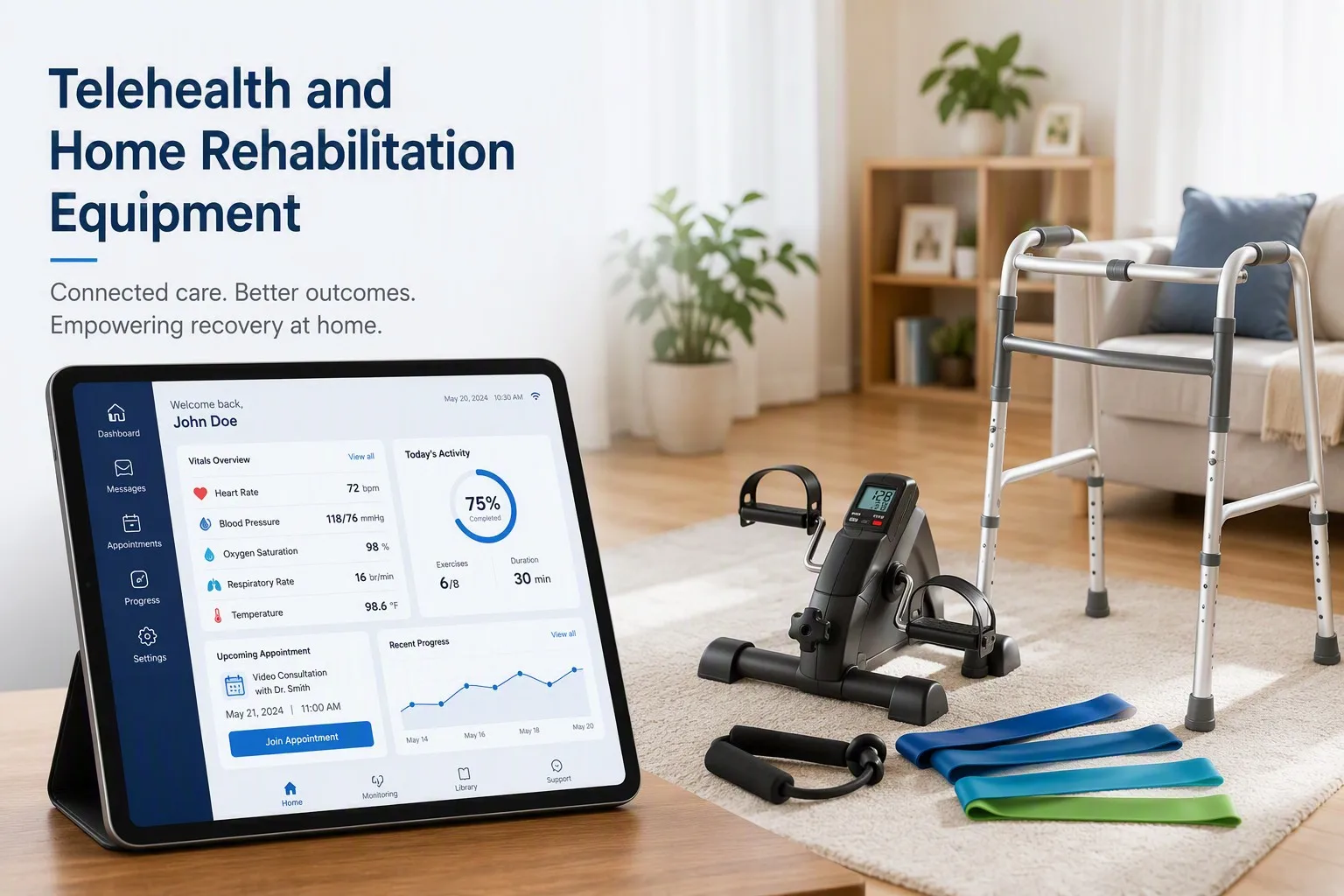
Telehealth and Home Rehabilitation: Why B2B Buyers Should Expand Their Mobility Aid Portfolios
Category: Industry News
Telehealth is accelerating demand for home rehabilitation equipment — and B2B buyers who expand their mobility aid portfolios now are positioned for the fastest-growing channel in post-acute care. Telehealth does not replace hands-on care; it moves the location of care. Remote monitoring, virtual physiotherapy, and tele-rehabilitation programs all assume patients have the right equipment at home. For distributors, DME providers, and home healthcare agencies, that means predictable, recurring demand for lightweight rollators, folding shower chairs, and portable exercise equipment. This article covers the growth data, the winning product categories, and how to package home rehab kits profitably.
Key Takeaways
- The global telehealth services market is projected to reach about USD 291 billion by 2030 (Grand View Research, 2024).
- Telehealth utilization remains roughly 38x pre-pandemic levels (McKinsey & Company, 2021).
- Lightweight rollators, folding shower chairs, and portable exercise equipment lead home rehab demand.
- Home-use products need professional certification plus tool-free, caregiver-friendly design.
- Bundled home rehab kits create higher-value orders for DME providers.
How Fast Is Telehealth Growing?
The post-COVID acceleration never reversed:
- The global telehealth services market is projected to grow at a compound annual rate above 30% from 2024 to 2030, reaching roughly USD 291 billion (Grand View Research, 2024).
- Telehealth utilization stabilized at about 38 times pre-pandemic levels in the US (McKinsey & Company, 2021).
- Medicare telehealth visits grew 63-fold between 2019 and 2020 (US Department of Health and Human Services).
- Industry analysts report telehealth consultations for physical therapy and post-operative care have increased more than 40% since 2024.
Why Does Telehealth Drive Demand for Home Equipment?
Four forces push rehabilitation equipment from clinical settings into private homes:
- Shorter hospital stays. Patients continue recovery at home under remote supervision.
- Chronic condition management. Programs for arthritis, COPD, and post-stroke recovery need ongoing home mobility support.
- Clinician-prescribed equipment. A walking aid prescribed during a virtual visit must arrive quickly and work safely without in-person instruction.
- Unsupervised use. Home devices run without clinical staff present, raising the bar for intuitive, fail-safe design.
Reimbursement reinforces the trend: more health systems pay for telehealth consultations and home-based rehab, converting one-off purchases into recurring budget lines.
Which Product Categories Are Benefiting Most?
Demand centers on professional-grade products with home-friendly design:
- Lightweight rollators. Foldable, portable models seniors can manage independently and caregivers can load into a car.
- Folding shower chairs. Compact, tool-free assembly, with backrests for safe home bathing.
- Portable exercise equipment. Therapy bands, balance tools, and accessories for clinician-directed home exercise.
- Adjustable canes and commodes. Staple items in home care packages.
Home-Use vs. Facility-Grade: What’s the Difference?
| Specification | Home-use models | Facility-grade models |
|---|---|---|
| Weight | Lightweight (6–9 kg rollators) | Heavier, fixed frames |
| Assembly | Tool-free, foldable | Permanent installation |
| Durability | Daily single-user cycles | High-volume multi-user cycles |
| Adjustability | User-level, one household | Extensive multi-user fitting |
| Certification | ISO 13485, CE/FDA | ISO 13485, CE/FDA |
“Home rehabilitation is a clinical setting now, just without walls,” says Dr. Rebecca Lawson, Director of Telehealth Services, National Home Healthcare Alliance. “The products we prescribe must be certified to professional standards, yet simple enough for a patient and family caregiver to use on day one.”
How Can B2B Buyers Package Home Rehab Kits?
The revenue opportunity for distributors and DME providers is bundling:
- Select core SKUs — a rollator, a shower chair, and an adjustable cane cover most telehealth discharge plans.
- Configure tiered bundle pricing — volume discounts for enrolled programs versus retail.
- Assemble the documentation pack — instructions, test reports, and certification files clinicians need before prescribing.
- Plan logistics — drop-ship to patient homes cuts inventory burden and speeds delivery.
What Should B2B Buyers Look for in a Home Rehab Supplier?
Procurement teams serving home healthcare should verify:
- Certification — ISO 13485 with CE and/or FDA compliance.
- Quality documentation — batch traceability and test reports for clinician-prescribed products.
- Low MOQs — home care programs need modest quantities across many SKUs.
- Customization — private labeling and configuration changes for local markets.
- Consistent supply — steady, recurring demand requires reliable lead times.
JiNDA Health Care builds rehabilitation equipment and walkers and rollators to ISO 13485 for 18 years, with low MOQs and private-label flexibility. Contact our sales team for catalogs, certification documents, and quotations tailored to your distribution model.
FAQ
How does telehealth create demand for home rehabilitation equipment?
Telehealth moves post-acute and chronic care into the home, and every remote therapy program requires walking aids, bathroom safety products, and exercise tools.
Which products benefit most from the telehealth shift?
Lightweight rollators, folding shower chairs, adjustable canes, and portable exercise equipment benefit most — clinically effective yet easy to use at home.
What is the difference between home-use and facility-grade equipment?
Home-use models are lighter, foldable, and tool-free; facility-grade models are heavier, fixed, and built for heavy multi-user cycles.
How can distributors profit from home rehab kits?
Distributors can profit by bundling core SKUs, offering tiered volume pricing, providing documentation for clinicians, and drop-shipping to patient homes.
What certifications should home rehab equipment carry?
Home rehab equipment should carry ISO 13485 certification with CE and/or FDA compliance, plus test reports for load, fatigue, and corrosion.
Written by JiNDA Health Care | Reviewed by Dr. James Palmer, PT, DPT, ATP — Clinical Education Advisor
Last updated: August 2026