
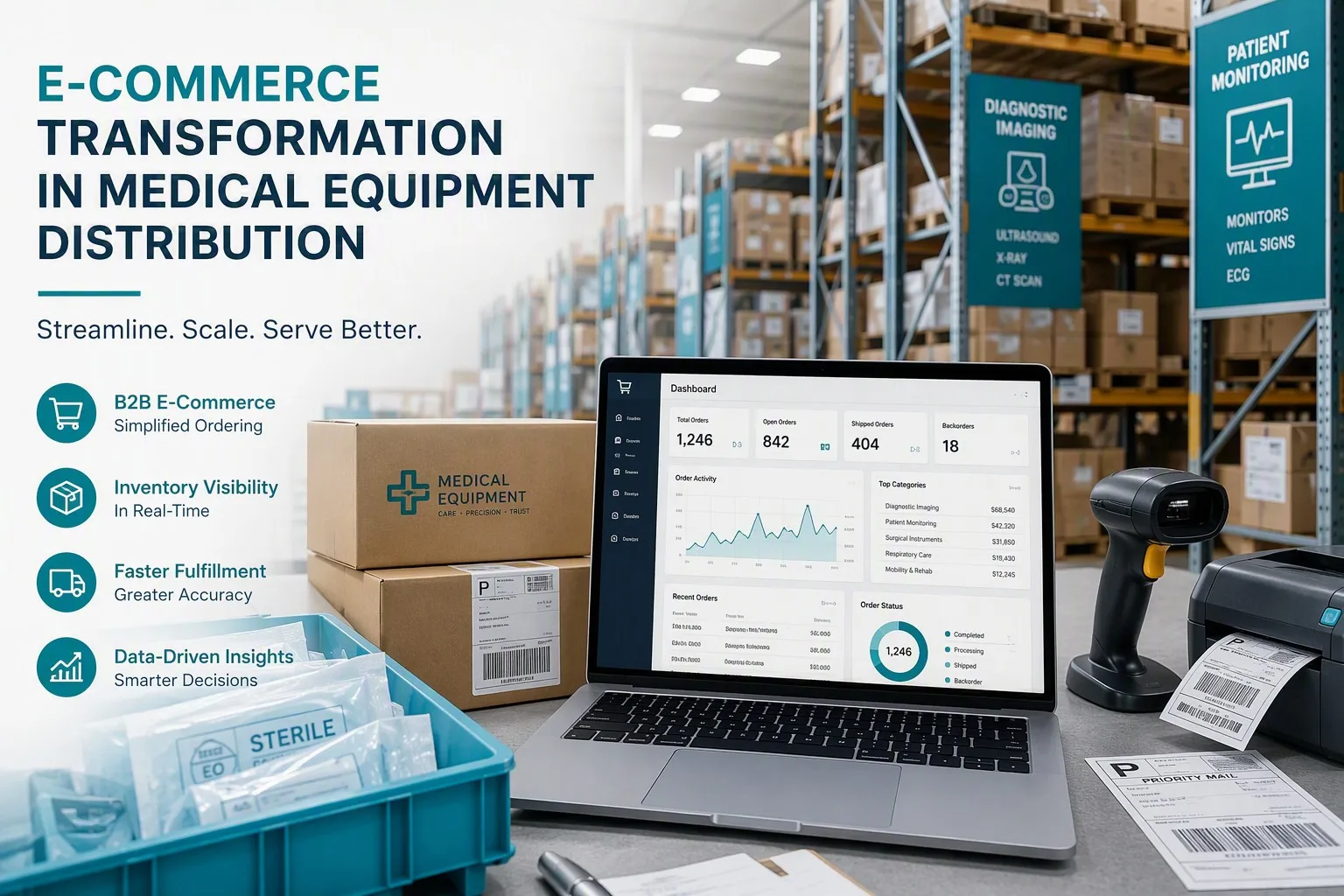
B2B E-Commerce in Medical Equipment: How Digital Procurement Is Changing Distribution
Category: Market Trends
B2B e-commerce is rewiring how medical equipment is bought and sold — and distributors, DME providers, and institutional buyers who adopt digital procurement are gaining measurable cost and speed advantages. US B2B e-commerce sales are forecast to reach USD 3.0 trillion by 2027, and healthcare buyers increasingly expect real-time inventory, bulk pricing, and compliance documentation online. This article explains how digital procurement platforms work, what is changing in the traditional distributor model, and what buyers should demand from digital-first suppliers.
Key Takeaways
- US B2B e-commerce is forecast to hit USD 3.0 trillion by 2027 — about a quarter of all B2B sales (Forrester, 2023).
- Global B2B e-commerce was valued near USD 7.9 trillion in 2022 and is growing at roughly 18% annually (Grand View Research, 2023).
- Gartner projects 80% of B2B sales interactions will be digital by 2025.
- Digital procurement shifts value from order-taking to data, logistics, and compliance documentation.
- Suppliers with online catalogs, RFQ systems, and warehouse stock visibility shorten buyer qualification cycles.
How Big Is B2B E-Commerce in Medical Equipment?
The numbers are decisive:
- US B2B e-commerce sales will reach USD 3.0 trillion by 2027, roughly 25% of all B2B sales in the country (Forrester, 2023).
- The global B2B e-commerce market was valued at approximately USD 7.9 trillion in 2022, with a projected CAGR of about 18% through 2030 (Grand View Research, 2023).
- 80% of B2B sales interactions will happen in digital channels by 2025 (Gartner, 2020).
- 65% of B2B companies now offer e-commerce, up from 53% in 2020 (McKinsey & Company, 2021).
How Do Digital Procurement Platforms Work for Medical Equipment?
Three models dominate medical equipment procurement:
Marketplaces
Multi-vendor platforms aggregate catalogs, standardize product data, and let buyers compare specifications, pricing, and compliance documents side by side.
Direct-to-Provider Portals
Manufacturers and distributors run branded portals with negotiated pricing, order history, and reorder workflows, often integrated with the buyer’s ERP.
EDI Integration
Electronic Data Interchange automates purchase orders, invoices, and shipment notices using GS1 standards, removing manual entry and error.
How Is E-Commerce Changing the Traditional Distributor Model?
Digital procurement creates both risk and opportunity for distributors:
- Disintermediation risk. Manufacturers can sell direct through portals, compressing the traditional middle layer.
- Data advantage. Distributors with real-time inventory visibility become more valuable, not less — buyers pay for availability.
- Value-added services. Compliance documentation, logistics, kitting, and financing move to the center of the distributor’s role.
“The distributor role is shifting from moving boxes to managing data and compliance,” says Karen Whitfield, Senior Director of Digital Commerce, National Healthcare Supply Chain Association. “Buyers pay for certainty — real-time stock, clean documentation, and predictable delivery — not for the order-taking itself.”
What Do B2B Buyers Want from Medical Equipment E-Commerce?
Healthcare procurement teams consistently prioritize five capabilities:
- Real-time inventory — live stock visibility across warehouses, including US-based inventory for domestic lead times.
- Bulk and tiered pricing — transparent volume pricing and easy quote requests (RFQ).
- Compliance documentation — downloadable certificates, test reports, and declarations of conformity.
- Order tracking — shipment status from order to delivery.
- Account-based workflows — negotiated catalogs, approval chains, and reorder lists.
How Should Buyers Evaluate a Digital-First Supplier?
- Check inventory visibility — confirm real-time stock data before placing volume orders.
- Test the RFQ process — response time and document completeness reveal operational maturity.
- Verify compliance files — certificates should be current, scoped, and downloadable.
- Assess integration — EDI or API support reduces manual work in your own systems.
JiNDA’s Digital Procurement Capabilities
JiNDA Health Care supports digital procurement with an online product catalog, a structured RFQ system for bulk pricing and documentation requests, and US warehouse stock visibility for faster domestic lead times. Wholesalers and distributors can browse the full range — from rollator walkers to bathroom safety equipment — and contact JiNDA for quotes, certificates, and supply agreements.
FAQ
How large is B2B e-commerce in medical equipment?
US B2B e-commerce is forecast to reach USD 3.0 trillion by 2027, and healthcare buyers increasingly expect digital catalogs, real-time inventory, and online quoting.
What is a digital procurement platform?
A digital procurement platform is a marketplace, portal, or EDI connection that automates product discovery, quoting, ordering, and documentation exchange between buyers and suppliers.
Will e-commerce replace traditional medical equipment distributors?
E-commerce replaces order-taking, not distribution value — distributors that add real-time inventory, compliance documentation, and logistics remain essential.
What should buyers look for in a medical equipment e-commerce platform?
Buyers should look for real-time inventory, bulk pricing with RFQ support, downloadable compliance documentation, order tracking, and account-based workflows.
How does JiNDA support digital procurement?
JiNDA supports digital procurement with an online catalog, an RFQ system for bulk pricing and documentation, and US warehouse stock visibility.
Written by JiNDA Health Care | Reviewed by Dr. James Palmer, PT, DPT, ATP — Clinical Education Advisor
Last updated: August 2026